Anthropic launched Claude Fable 5.2 and Claude Mythos 5.2 on November 9, 2026. The models target hard technical work. They handle ambitious projects across fields and improve on coding, reasoning, and vision compared with earlier versions.
Claude Fable 5.2 and Mythos 5.2 share the same underlying model. Fable includes stronger safeguards against misuse in areas like cybersecurity and biology. The latest Claude version is available to everyone on paid plans.
Mythos has fewer of those restrictions. Organizations working on beneficial projects in cybersecurity or biomedical research can apply for it through Anthropic’s Life Sciences and Cyber Verification Programs.
Quick summary of when to use which
| Situation | Recommended model | Notes |
|---|---|---|
| Everyday coding and knowledge work | Opus 5.5 | Strongest daily option |
| Very large or open-ended technical projects | Fable 5.2 | Available to all paid users |
| Advanced cybersecurity work | Mythos 5.2 | Needs verification approval |
| Advanced biomedical / life-sciences research | Mythos 5.2 | Needs verification approval |
| Hardware design, robotics, hard science | Fable 5.2 or Mythos 5.2 | Depends on the exact domain |
Claude Fable 5.2 & Claude Mythos 5.2: Speed, price, and basic specs
The new models generate outputs up to 30% faster than Fable 5.1 and Mythos 5.1. Testers also said they communicate more clearly than the previous Fable and Mythos versions. Those earlier releases already had several documented Fable 5.1 use cases to compare against.
Claude Fable and Mythos 5.2 Pricing
Standard pricing is $8 per million input tokens and $40 per million output tokens.
That is lower than the earlier $10 and $50 rates. An optional fast mode runs up to 2.5 times quicker and costs $16 per million input tokens and $80 per million output tokens.
Both Claude Fable and Mythos 5.2 models support a 1 million token context window and up to 128,000 output tokens.
Adaptive thinking is always on. Users control how much thinking happens with an effort setting. Medium effort is the default in Claude apps and Claude Code.
Here is a simple pricing comparison:
| Model / Mode | Input (per million tokens) | Output (per million tokens) |
|---|---|---|
| Fable 5.1 / Mythos 5.1 | $10 | $50 |
| Fable 5.2 / Mythos 5.2 (standard) | $8 | $40 |
| Fable 5.2 / Mythos 5.2 (fast mode) | $16 | $80 |
How latest Claude Fable and Mythos models score against other Claude models
On most capabilities Anthropic measured, Fable 5.2 and Mythos 5.2 sit above Claude Opus 5.5. They also matched or beat recent Anthropic models on most alignment tests.
External groups reviewed them before release. Those groups include the AI Security Institute, Frontier Design, and METR Evals.
On FrontierCode 2.0, Fable 5.2 at High effort roughly matched Opus 5.5 at Max effort while using about half the cost per task.
At the highest effort setting, it posted the top score among released models Anthropic tested.
Concrete results from testing
The recent Claude Mythos and Fable 5.2 models handled several demanding projects during pre-release work.
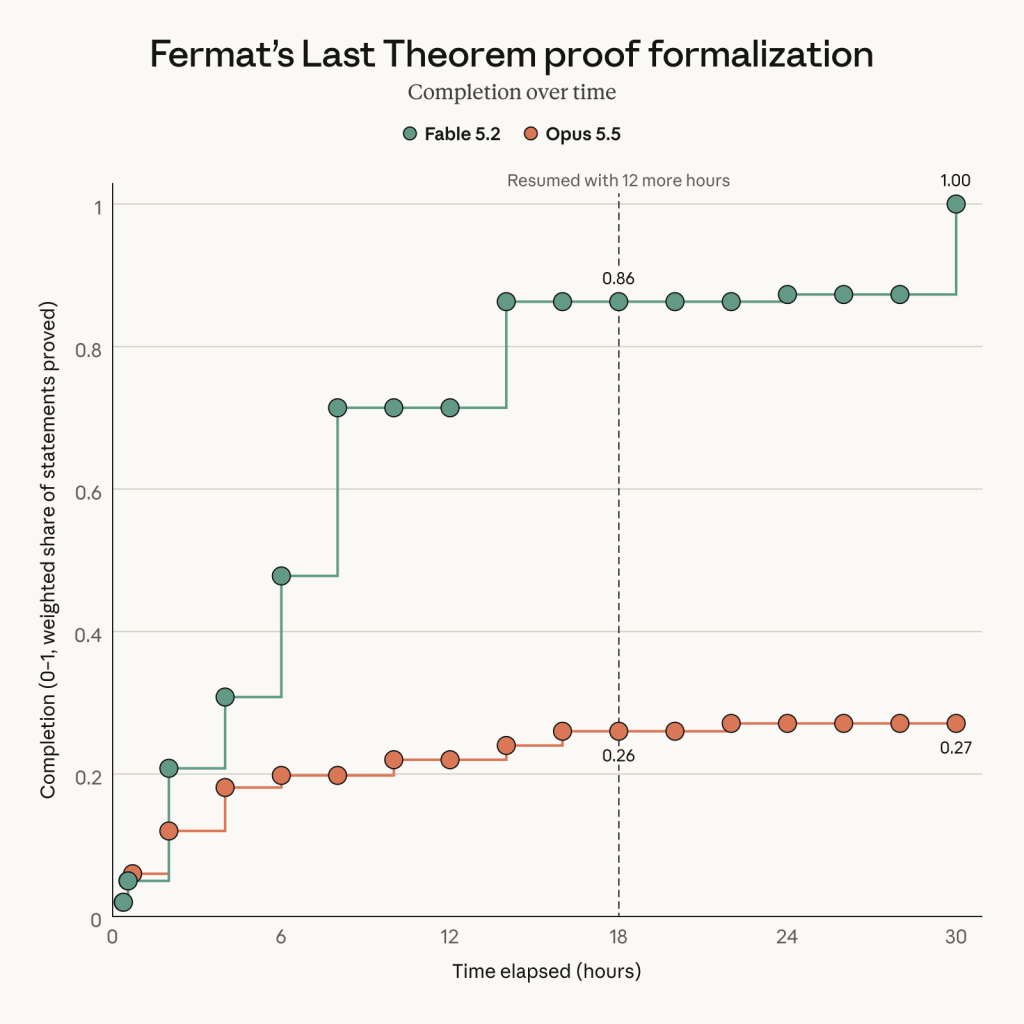
A team of 1,000 Fable 5.2 agents fully formalized Fermat’s Last Theorem in 30 hours. They translated the proof into a form a computer can check step by step. The same setup with Opus 5.5 finished only 26% of the work in 18 hours and made almost no further progress after 30 hours.
Mythos 5.2 found a new way to predict the full structure of protein shells called capsids. These shells deliver gene therapies. In tests it correctly modeled 28 of 34 capsids.
Researchers could use the approach to design capsids faster and at lower cost.
- From a one-paragraph prompt, Fable 5.2 designed three working electronic devices. One was a home voice assistant hub. The model wrote its own specifications, chose components, routed four-layer circuit boards, designed enclosures for 3D printing, and wrote the software.
Each board was ready for manufacture in under a day. All three devices worked without changes.
- In organic chemistry, the model received one image of each of four complex molecules. It had no internet access and could only use code. In about half an hour it produced complete synthesis routes. It checked its own plans atom by atom with code, replaced reactions that could damage the molecules, and flagged steps most likely to fail.
External collaborators rated the work at the level of an early graduate student. The molecules came from unpublished work in the labs of Noah Burns at Stanford, Timothy Newhouse at Yale, and Sarah Reisman at Caltech. The routes have not yet been tested in a lab.
- On the MIPLIB library of optimization problems, Claude beat the listed mathematical solutions in 72 of 203 open cases and proved optimality in 45 cases. One problem involved timing 42 trains to reduce peak power use.
Agents improved on the previous best timetable by 2.6% in under two hours and later proved no better schedule exists. The solutions were submitted to MIPLIB for public checking.
- Fable 5.2 also solved two open problems in theoretical physics related to black holes. In the first, it finished a calculation that had remained unsolved for 23 years. Physicists showed in 1983 that black holes form abruptly in certain larger theoretical universes as they heat up.
A 2003 calculation tested whether the same thing happens in extremely small universes. Fable 5.2 found the transition is abrupt there too. In the second problem it found the exact limit of the simplest version of a 15-year-old technique called modular bootstrapping.
That technique helps rule out candidate theories of quantum gravity. Both results appear in preprints.
- Fable 5.2 also improved at controlling physical robots, including tasks it had never been trained on.
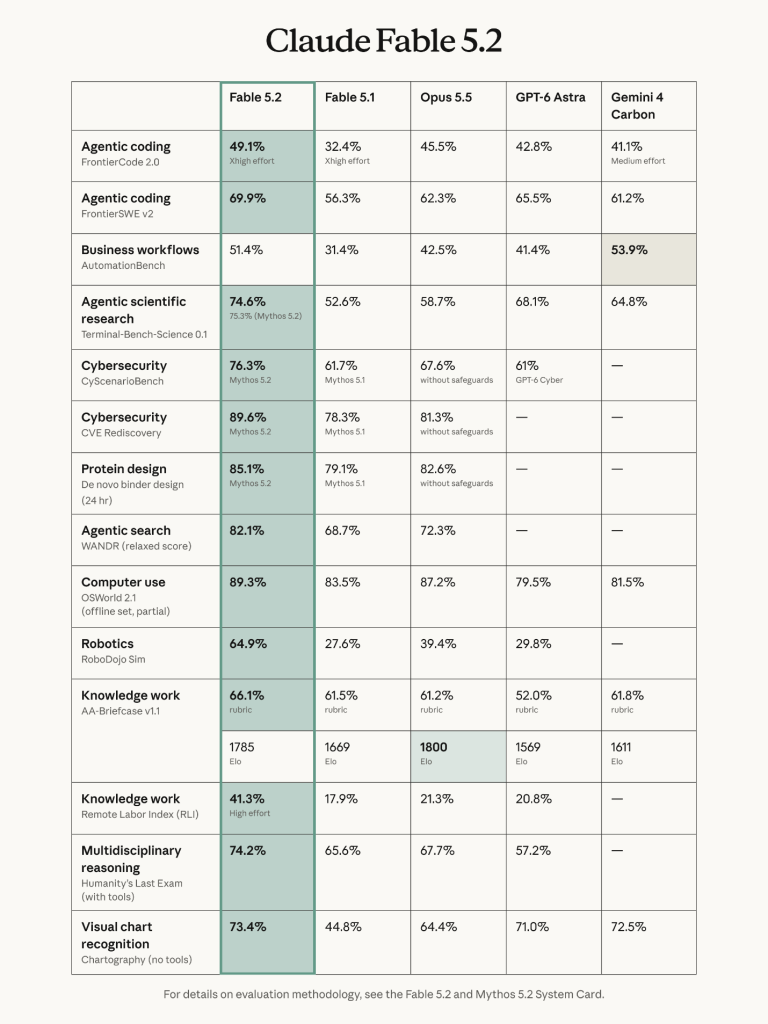
- On the RoboDojo benchmark with a simulated two-arm robot, it outperformed other models and most systems built specifically for robot control.
Claude Fable 5.2 and Mythos 5.2 Availability
Claude Fable 5.2 is available now on all paid Claude plans, the Claude Platform, and major cloud platforms. Developers can call it through the Claude API. Mythos 5.2 access is limited to approved organizations.
Closing
The release adds concrete capabilities in math formalization, chemistry planning, electronics design, optimization, physics calculations, and robot control. The price drop and speed increase make the models cheaper and faster to run than the previous versions for the same class of work. Fable 5.2 is the newest entry in a model-by-model history that goes back to 2023.
