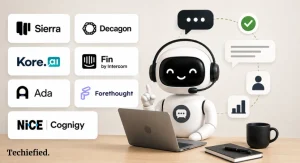
Sierra, Decagon, Kore.ai, Fin (formerly Fin by Intercom), Ada, Forethought, and NiCE Cognigy are the strongest Cresta alternatives for AI customer support agents if your goal is autonomous resolution rather than human agent assistance.
Cresta is built around a different job. Its platform combines AI Agent, Agent Assist, and Conversation Intelligence in one system, and it explicitly positions itself as unifying human and AI agents rather than replacing the human layer.
If you’re running a large human contact center and want AI to make agents better, Cresta fits. If you want AI to resolve tickets without a human touching most of them, look at the platforms below.
A quick shortlist:
- Sierra: best for enterprise autonomous customer service. Outcome-based pricing, voice and chat, backend system actions.
- Decagon: best for complex, multi-step resolution. Natural-language workflow definitions (AOPs), strong voice.
- Kore.ai: best for customizable enterprise agents. Multi-agent orchestration, 100+ connectors, no-code and pro-code.
- Fin: best for helpdesk-native support. Public per-resolution pricing, built into Intercom’s inbox.
- Ada: best for large-scale automated CX. Requires high ticket volume, unified reasoning engine across channels.
- Forethought: best for multi-agent support automation. Five coordinated agents (Solve, Triage, Assist, Discover, Agent QA), now owned by Zendesk.
- Cognigy: best for enterprise voice and conversational AI. Now part of NiCE, 100+ languages.
How do AI customer support agents differ from Cresta AI Agent Assist?
AI customer support agents handle customer conversations themselves. Agent assist gives human representatives real-time help while they handle the conversation.
The distinction affects the system you need, the workflows you automate, and what happens when AI cannot resolve an issue.
Sierra and Decagon both connect directly to CRMs, order systems, and billing platforms to do exactly this. Human handoff still exists in every serious platform on this list, but it’s the exception path, not the default one.
Cresta’s own product architecture reflects this split internally. Its AI Agent product handles autonomous conversations.
Cresta AI Agent Assist product augments humans. Its Conversation Intelligence layer analyzes both. Cresta runs all three from one platform and one data layer, which is the pitch: don’t pick a lane, run AI and human agents together.
Sierra, Decagon, and most of the platforms in this article are automation-first. They were built assuming the AI does the resolving, and the human layer is a fallback, not a parallel operation.
Neither model is wrong. Cresta answers “how do we make our human contact center better with AI.”
Sierra and Decagon answer “how do we resolve tickets without a human contact center scaling alongside volume.”
How We Selected The Best Cresta Alternatives For AI Customer Support
The platforms in this list were evaluated against the parts of customer support that matter when AI handles conversations directly.
We looked at:
- Autonomous resolution: Can the AI resolve customer issues without a human agent?
- System actions: Can it update accounts, process requests, or trigger workflows in connected systems?
- Human handoff: Can unresolved conversations move to a human with the relevant context?
- Channel coverage: Does it support chat, email, voice, SMS, or other customer channels?
- Knowledge and context: Can the AI use company knowledge and customer history when responding?
- Workflow control: Can teams define rules, procedures, and actions for specific support scenarios?
- Monitoring and governance: Can teams review conversations, control AI behavior, and track performance?
- Pricing: Is pricing public, usage-based, seat-based, or custom?
Why Sierra is Best For Enterprise Autonomous Customer Service
Sierra is a strong Cresta alternative for large brands that want AI agents to handle customer conversations across multiple channels. Its agents support phone, chat, SMS, messaging, and email.
Sierra’s AI agents can work through customer requests and take actions in connected business systems. The platform also supports human handoff when an AI agent cannot complete a request.
Key features
- Cross-channel AI agents for phone, chat, SMS, messaging, and email.
- Business-system actions that let agents do more than return information.
- Human handoff for conversations that need human intervention.
- Customer context across interactions.
- AI agent management for testing and improving agent behavior.
- Long-horizon agents, including Sierra’s Horizon product, which is designed to improve through repeated interactions.
Why choose Sierra over Cresta?
Sierra makes autonomous customer resolution the center of its product. Cresta combines autonomous AI with live agent assistance, quality management, and conversation intelligence.
That makes Sierra a better fit for an organization whose main goal is to move more customer conversations from human support to AI resolution.
Best for
Sierra is best for large consumer brands with high support volumes and complex customer-service workflows. Its channel coverage and ability to take actions in business systems make it suitable for support teams that want AI to handle complete customer interactions.
Sierra uses custom enterprise pricing, so prospective customers need to contact the company for a quote.
Decagon is best for complex AI customer support resolution
Decagon is an AI customer support platform built around autonomous resolution. Its agents can handle customer conversations across chat, voice, email, SMS, and other channels, then take actions in connected business systems.
The platform uses Agent Operating Procedures (AOPs) to define how agents handle specific tasks. These procedures can cover actions such as refunds, subscription changes, account updates, and appointment scheduling.
Key features
- Autonomous AI agents that resolve customer requests without human intervention.
- AOPs for defining rules and workflows in natural language.
- System integrations with support, CRM, knowledge base, and communication platforms.
- Omnichannel support across chat, voice, email, SMS, and messaging.
- Human handoff when an issue requires escalation.
- Customer memory that carries context across conversations.
- Outbound voice agents for proactive customer interactions.
Decagon’s current product supports chat across web, mobile, SMS, WhatsApp, and other messaging channels. Its integrations include systems such as Zendesk, Salesforce, Amazon Connect, RingCentral, Intercom, Confluence, and Contentful.
Why choose Decagon over Cresta?
Decagon is a stronger fit when AI-led resolution is the main goal. Its agents are designed to complete customer-service tasks through connected systems, while Cresta combines autonomous AI agents with agent assistance, conversation intelligence, and quality management.
The difference also shows up after escalation. Decagon passes the conversation to a human with context. Cresta continues supporting the human agent with real-time guidance after the handoff.
Decagon uses per-conversation or per-resolution pricing. The company says larger resolution commitments can reduce the per-resolution rate, while its published pricing guidance says most customers have chosen per-conversation pricing. Exact rates aren’t publicly listed.
Best for
Decagon is best for digital-first support teams that want AI to resolve complex customer requests and take actions in business systems. It is particularly suited to organizations with engineering resources that can manage integrations, workflows, and ongoing agent configuration. Cresta’s own 2026 comparison reaches a similar conclusion, describing Decagon as a fit for digital-first operations focused on maximizing AI-handled resolution.
Its current product has also expanded beyond reactive support. Decagon’s 2026 Proactive Agents release adds user memory and outbound voice, allowing agents to initiate conversations and retain customer context across interactions.
Why Kore.ai is Best For Custom Enterprise AI Agents
Kore.ai is an enterprise conversational AI platform that lets organizations build AI agents for customer and employee use cases. It supports both no-code and pro-code development, with tools for building, deploying, and managing conversational applications across channels.
Kore.ai is a useful Cresta alternative for organizations that need custom AI agents across several business functions, rather than a platform focused primarily on contact center operations.
Key features
- No-code and pro-code development for building AI agents.
- Multi-agent orchestration for complex workflows.
- Omnichannel deployment across voice, chat, SMS, and web.
- Enterprise integrations with business systems.
- Prebuilt conversational applications for industries and business functions.
- Human handoff when AI needs human intervention.
Why choose Kore.ai over Cresta?
Kore.ai is a better fit when your organization needs one conversational AI platform across multiple enterprise use cases. Cresta is built specifically around contact center operations, combining AI agents with agent support, conversation intelligence, and quality management.
Kore.ai can make more sense for an enterprise that wants teams to build and manage custom AI applications across customer service, employee support, and other workflows.
Cresta is a stronger choice when the core requirement includes contact center analytics, quality management, and real-time support for human agents alongside AI automation.
Best for
Kore.ai is best for large enterprises that need highly customized AI agents across multiple channels and business workflows. It fits organizations with internal technical teams that want control over how conversational AI applications are built and deployed.
Why Fin by Intercom is best for helpdesk-based AI customer support
Fin by Intercom is an AI customer service agent that answers customer questions, follows configured procedures, takes actions in connected systems, and hands conversations to human agents when needed. It can run inside Intercom or connect to an existing helpdesk such as Salesforce and HubSpot.
Fin supports customer service across chat, email, and phone, with additional channels available through Intercom’s plans. Its external-helpdesk version can also take actions in connected systems and pass conversations to the existing support inbox.
Key features
- AI customer support agent that resolves customer questions and follows configured procedures.
- Knowledge-based answers using a company’s support content.
- Actions on external systems for tasks that require more than a written response.
- Human handoff when Fin cannot resolve a conversation.
- Multilingual support across supported channels.
- Existing-helpdesk support for teams using platforms such as Salesforce or HubSpot.
Fin is priced at $0.99 per outcome. Intercom defines an outcome as a successful resolution, a procedure handoff, or a disqualification. A customer conversation is charged for one outcome even when Fin takes multiple actions during that conversation.
- Teams using Fin with an existing helpdesk pay $0.99 per outcome with minimum commitments and no seat, setup, integration, or platform fees.
- Using Fin with Intercom also requires an Intercom plan.
- Current annual pricing starts at $29 per seat per month for Essential, with Advanced at $85 and Expert at $132 per seat per month.
Why choose Fin over Cresta?
Fin makes the most sense when helpdesk-based customer support automation is the main requirement. It can be added to an existing helpdesk without replacing the team’s current support system.
Cresta has a broader contact center focus. Its platform combines AI agents with real-time agent assistance, conversation intelligence, and quality management.
Fin is therefore a strong option for SaaS and support teams that already have a helpdesk and want an AI agent to resolve routine customer requests within that environment.
Best for
Fin by Intercom is best for SaaS and customer support teams that want to add an AI agent to their existing helpdesk. Its external-helpdesk option is particularly useful for teams that want AI resolution without migrating their support operation to Intercom.
Why Ada is best for high-volume automated customer support
Ada is an AI customer service Cresta alternative built for automated customer interactions across digital channels. Its AI agents can answer questions, use customer and business context, take actions through integrations, and transfer conversations to human agents when required.
Ada is designed for organizations with large customer-service volumes. It supports automated workflows across channels such as web chat, messaging, and voice. Ada also includes AI tools for controlling AI behavior and measuring automated support performance.
Key features
- AI customer service agents for automated customer conversations.
- Knowledge-based responses using company content.
- Actions and workflows through integrations with business systems.
- Omnichannel support across digital customer-service channels.
- Human escalation when an AI agent cannot complete a request.
- Analytics and reporting for monitoring automated conversations.
- Multilingual support for global customer-service operations.
Why choose Ada over Cresta?
Ada fits organizations that want to automate a large share of repetitive customer interactions through AI agents. Cresta covers that use case too, but its platform also puts significant focus on human-agent assistance and contact center quality management.
The choice comes down to the support operation. A team focused on AI-led customer resolution across high conversation volumes can consider Ada.
A contact center that needs AI resolution alongside live agent guidance and automated quality management has a broader use case for Cresta.
Ada uses custom pricing for enterprise deployments, so buyers need to contact the company for a quote.
Best for
Ada is best for large customer-service teams that want to automate high volumes of repetitive support conversations across multiple channels.
It is a particularly relevant Cresta alternative when the main metric is how many customer interactions AI can resolve without human involvement.
Why Forethought is best for AI-powered ticket resolution
Forethought is a Cresta alternative customer support AI platform. It has separate agents for resolution, agent assistance, knowledge discovery, and ticket triage. Its Resolve agent handles customer issues across chat, email, voice, and other channels, while its other agents support human teams and support operations.
Forethought was acquired by Zendesk in early 2026. Zendesk began selling Forethought capabilities as an add-on to its customers in June 2026.
Forethought’s products continue to be available as part of the wider platform.
Key features
- AI Resolve agent that handles routine customer issues across multiple channels.
- AI Assist that gives human agents ticket summaries, response suggestions, and workflow guidance.
- AI Triage that classifies, prioritizes, and routes support tickets.
- AI Discover that identifies knowledge gaps and support-content needs.
- Autoflows that let teams define support workflows in natural language.
- Backend actions through connected systems and support workflows.
- Omnichannel support covering email, chat, voice, Slack, API, and mobile.
Forethought says its AI agents resolve more than 60% of issues for Airtable and reports an average resolution rate of 84% across its platform.
Those are vendor-reported figures, so they should be treated as product claims rather than independent benchmarks.
Why choose Forethought over Cresta?
Forethought fits support teams that work primarily through ticketing and helpdesk workflows. Its Resolve, Triage, Discover, and Assist agents cover different parts of the support process. On the flip side, Cresta combines autonomous customer-service AI with real-time agent assistance, conversation intelligence, and contact center quality management.
The Zendesk acquisition also makes Forethought particularly relevant for organizations already invested in Zendesk. Zendesk now sells Forethought AI agents directly to its customers, including capabilities for autonomous responses, ticket classification, routing, and agent assistance.
Forethought uses custom pricing. Its website directs prospective customers to contact sales for product and pricing details.
Best for
Forethought is best for support teams that want AI to resolve tickets while keeping human agents involved for complex cases. It is especially relevant for companies using Zendesk or other major helpdesk platforms and looking for AI-driven resolution, triage, knowledge management, and agent assistance in the same support workflow.
Why NiCE Cognigy is best for enterprise conversational and agentic AI
Cognigy is now part of NiCE. NiCE completed its acquisition of Cognigy on September 8, 2025. The product is now marketed as NiCE Cognigy. NiCE says Cognigy’s technology is available both within its CXone platform and as a standalone offering.
NiCE Cognigy provides enterprise conversational and agentic AI for customer service. Its AI agents can handle voice and digital interactions, execute workflows across connected systems, and support complex customer journeys.
Key features
- AI agents for voice and digital customer interactions.
- Agentic workflows that let AI take actions across connected systems.
- Conversational AI for complex customer-service interactions.
- Omnichannel deployment across voice and digital channels.
- AI agent testing through NiCE Cognigy Simulator.
- MCP connectivity for connecting AI agents to external systems and services.
- Enterprise governance and monitoring for production AI deployments.
NiCE launched new Cognigy capabilities in March 2026 for generating, testing, and scaling AI agents, including support for MCP.
Why choose NiCE Cognigy over Cresta?
NiCE Cognigy is a strong choice for enterprises that need complex conversational AI and agentic workflows across customer-service operations. NiCE now combines Cognigy’s conversational and agentic AI with CXone’s contact center capabilities, bringing AI agents, human agent support, analytics, and other CX functions into the same broader platform.
The product is also relevant when AI needs to perform complex operations rather than only answer customer questions. Forrester’s 2026 evaluation described NiCE Cognigy as a fit for organizations deploying complex, agentic conversational AI applications at scale.
Cognigy’s acquisition by NiCE changes how it should be evaluated as a Cresta alternative for AI customer support agents. Buyers comparing the two should assess NiCE Cognigy and the broader CXone platform.
Best for
NiCE Cognigy is best for large enterprises that need conversational AI, voice automation, and agentic workflows across complex customer-service environments. It is particularly relevant for organizations already considering NiCE CXone or looking for enterprise AI agents that can operate across voice, digital channels, and connected business systems.
Quick Comparison on Cresta Alternatives for AI Customer Support Agents
If the goal is autonomous customer support, these seven Cresta alternatives for AI agent assist software for support teams are the strongest options from the shortlist.
| Cresta Alternative for AI Customer Support | Best for | Autonomous resolution | Voice | Human handoff | Pricing |
|---|---|---|---|---|---|
| Sierra | Enterprise AI agents | Yes | Yes | Yes | Outcome-based, custom |
| Decagon | Complex support automation | Yes | Yes | Yes | Custom |
| Kore.ai | Custom enterprise AI agents | Yes | Yes | Yes | Custom |
| Fin by Intercom | Helpdesk automation | Yes | Yes, Fin Voice | Yes | From $0.99/outcome |
| Ada | Enterprise CX automation | Yes | Yes | Yes | Custom |
| Forethought | Multi-agent support | Yes | Yes | Yes | Custom |
| NiCE Cognigy | Voice and conversational AI | Yes | Yes | Yes | Custom |
Sierra supports chat, SMS, WhatsApp, email, voice, and ChatGPT through a single AI agent. It uses outcome-based pricing rather than publishing a standard per-seat plan.
Decagon supports digital channels and voice through integrations such as Amazon Connect and RingCentral. Its agents can take actions in connected support systems and hand conversations to human agents when needed.
Kore.ai supports enterprise conversational AI across voice and digital channels, with tools for building and deploying custom AI agents. Pricing is generally handled through custom enterprise quotes.
Fin by Intercom supports chat and email, with Fin Voice available for phone support. Fin costs $0.99 per outcome for chat and email. Phone pricing requires contacting Intercom sales. Fin can also hand conversations to human agents in the existing helpdesk.
Ada supports Chat, Voice, Email, Social, and third-party channels. Its Voice AI can complete tasks and transfer calls to human agents when necessary.
Forethought offers AI agents for chat and mobile on its Team plan, while Professional adds email, voice, and Slack. Its pricing page directs customers to request a quote rather than publishing standard prices.
NiCE Cognigy should be evaluated as part of NiCE following NiCE’s acquisition of Cognigy. Its platform supports conversational and agentic AI across voice and digital channels, with human handoff and enterprise workflow capabilities.
Which Cresta Alternative Is Best for AI Customer Support Agents?
The best choice for AI agent assist software for support teams on what you want the AI agent to actually do.
- Best overall: Sierra. Its focus on autonomous customer service across voice and digital channels makes it the strongest general-purpose option for enterprises that want AI to own customer interactions.
- Best for complex workflows: Decagon.
- Best for enterprise customization: Kore.ai.
- Best for helpdesk automation: Fin by Intercom.
- Best for large-scale CX automation: Ada.
- Best for multi-agent support operations: Forethought.
- Best for voice and conversational AI: NiCE Cognigy.
How to Choose the Right Cresta Alternative for AI Customer Support Agents
The right Cresta alternative for AI agent assist software for support teams depends on what you want the AI to handle and how deeply it needs to connect with your support operation.
1. Resolution capability
Check whether the AI can resolve complete customer requests or only answer questions. Look for support for multi-step tasks, troubleshooting, transactions, and other actions that lead to an actual resolution.
2. Backend system access
An AI agent needs access to the systems where customer actions happen. Check whether it can securely connect to your CRM, helpdesk, billing system, order management platform, or other business tools.
3. Human handoff
AI should know when to stop. Check whether unresolved conversations can reach the right human agent with the conversation history and relevant context intact.
4. Voice and digital coverage
Check the channels your customers actually use. Depending on your operation, that could include web chat, email, SMS, WhatsApp, social messaging, and voice.
5. Knowledge and context
The AI should be able to use your current knowledge and customer information rather than relying on generic answers. Look for support for knowledge bases, customer history, live data, and connected systems.
6. Governance and monitoring
Enterprise AI needs controls. Look for tools to test agents, monitor conversations, set guardrails, review performance, and identify when an agent is producing poor or unsafe results.
7. Pricing model and total cost
Compare more than the advertised AI-agent price. Calculate the expected cost based on conversations, resolutions, seats, channels, integrations, implementation, and human escalation. For example, Fin charges per outcome, while some enterprise platforms use custom pricing.
Final Verdict on Cresta Alternatives for AI Customer Support Agents
Cresta is a strong choice when you want one CX platform combining autonomous AI, human-agent assistance, and conversation intelligence. Sierra and Decagon are stronger Cresta competitors when autonomous resolution is the main objective. Fin, Ada, Kore.ai, Forethought, and NiCE Cognigy make more sense for specific helpdesk, enterprise, or conversational AI requirements. The right Cresta competitor for AI sales coaching ultimately depends on the channels, workflows, integrations, and level of human involvement your support operation needs.
FAQs About Cresta Alternatives For AI Customer Support
Q#1. Will AI eventually replace call center agents?
No, AI is more likely to replace repetitive call center tasks than entire agent roles. AI can handle routine queries, routing, and basic transactions. Alternatively, human agents remain important for complex problems, emotional conversations, exceptions, and decisions requiring judgment.
Q#2. What is the best Cresta alternative for AI customer support?
Sierra is the strongest overall alternative when autonomous customer service is the primary goal. Decagon, Ada, Fin, Kore.ai, Forethought, and NiCE Cognigy are better fits for specific workflows and support environments.
Q#3. Is Sierra a good alternative to Cresta?
Yes. Sierra focuses on autonomous AI agents that resolve customer interactions, while Cresta combines AI agents with agent assist, conversation intelligence, and quality management.
Q#4. Is Decagon better than Cresta for AI customer support?
Decagon can be a better fit when the priority is autonomous resolution and multi-step support workflows. Cresta is broader when you also need real-time agent assistance and contact-center intelligence.
Q#5. What is the best Cresta alternative for autonomous customer service?
Sierra is the strongest general choice for autonomous customer service, with Decagon particularly suited to complex support workflows. The better option depends on your channels, integrations, and workflow requirements.
Q#6. What is the best Cresta alternative for helpdesk automation?
Fin by Intercom is a strong choice for helpdesk-based automation because it can work with Intercom or an existing helpdesk and hand conversations to human agents.
Q#7. Is Fin by Intercom a Cresta alternative?
Yes. Fin is an AI customer service agent that can resolve conversations, take actions through connected systems, and hand off to human agents.
Q#8. Is Kore.ai a Cresta alternative?
Yes. Kore.ai is an enterprise AI platform for building agents that can understand context and take actions across channels and languages.
Q#9. What is the difference between Cresta and an AI customer support agent?
An AI customer support agent handles customer conversations autonomously and can take actions to resolve them. Cresta provides autonomous AI agents but also combines them with agent assist and conversation intelligence.
Q#10. Does Cresta provide autonomous AI customer support?
Yes. Cresta AI Agent can resolve customer conversations end to end across voice and digital channels, including multi-step workflows and human handoffs.
Q#11.How much do Cresta alternatives cost?
Pricing varies widely, with enterprise platforms often using custom quotes and some products using usage-based pricing. Fin, for example, currently charges $0.99 per outcome for its AI agent, while Intercom also charges a separate seat price.
