If you’re looking for a free stock screener for penny stocks that actually works, three names come up frequently. These include Finviz, TradingView, and the OTC Markets Group screener. Each one does something the others don’t.
- Finviz gives you the most filters.
- TradingView gives you the best charts and real-time OTC quotes.
- OTC Markets gives you the compliance data no one else has, like whether a company even files financials with the SEC.
None of them do everything. If you trade penny stocks, especially ones on OTC or Pink Sheets, you’ll probably need to use two of these together.
What’s The Best Free Stock Screener For Penny Stocks Right Now?
Finviz is the strongest all-around free screener. It has over 60 filters covering price, volume, float, and basic fundamentals, and you don’t need an account to use it.
But Finviz has no dedicated OTC toggle. If you want OTC-only results, you have to combine the Exchange, Price, and Volume filters yourself. It takes a few minutes the first time.
For OTC and Pink Sheet names specifically, the OTC Markets Group screener is better. It’s the only free tool that tells you a stock’s market tier (OTCQX, OTCQB, or Pink) right in the results.
TradingView sits in the middle. It’s not as deep on filters as Finviz, and it doesn’t have the compliance data OTC Markets has. But it shows real-time OTC quotes for free, and its charts are better than either of the other two.
If charts matter most, a dedicated charting platform goes further still.
Here’s how they compare side by side:
| Tool | Best for | OTC/Pink coverage | Data delay |
|---|---|---|---|
| Finviz | Filter depth (60+ filters) | Partial, no dedicated toggle | About 1 minute |
| OTC Markets Screener | Compliance and tier data | Full, direct from the source | Real-time tier data |
| TradingView | Charting and mobile use | Real-time OTC quotes on free plan | Real-time |
| Yahoo Finance | Simplicity for beginners | Limited | 15 to 20 minutes |
🡪 Want to filter fast? Use Finviz.
🡪 Want to know if a stock is legitimate before you buy it? Use OTC Markets.
🡪 Want to watch price action live? Use TradingView.
What Does “Free” Actually Mean On These Screeners?
Free doesn’t mean full access. On most stock screeners, the filtering itself is free. What you lose is speed, alerts, and export.
Take Finviz. The screener has over 60 filters, and none of them require an account. But quotes on the free plan are delayed by 1 minute, and futures or options data is delayed by 15 minutes.
You also can’t export your results to a spreadsheet. That’s locked behind Finviz Elite, which starts at $39.50 a month.
TradingView works a similar way. The free plan gives you filtering and charting, but you’re limited on saved screeners and you’ll see ads. You get one chart layout open at a time instead of several.
Yahoo Finance is the most open of the group. It doesn’t gate filtering behind a paywall, but its quotes run 15 to 20 minutes behind, which is too slow for anyone trying to catch a fast move.
If you want quotes with no delay at all, you usually need a funded brokerage account, not a paid screener subscription. Webull and Fidelity both hand you real-time data once your account is open, at no extra cost.
Do I Need a Paid Plan For Penny Stocks Specifically?
Only if you’re trading intraday.
A 1-minute delay on Finviz’s free plan is not a big deal for swing trades held over days.
But if you’re watching for a volume spike in real time, even a 1-minute lag on a stock that just moved 20% can mean you’re already too late.
The same trade-off shows up for paid upgrades in general.
Which Free Screener Covers OTC and Pink Sheet Stocks?
The OTC Markets Group screener is the one built for this. It’s free.
It’s the only stock screening tool that shows you a stock’s market tier right in the results: OTCQX, OTCQB, or Pink. That tier tells you whether a company files real financials with the SEC or reports nothing at all.
Finviz can still get you there, just not directly. There’s no OTC toggle. You have to set Exchange to “OTC” and stack it with Price and Volume filters yourself.
It takes a few minutes the first time you do it. After that, you can save the combination and reuse it.
TradingView and Webull both show real-time OTC quotes on their free plans. A lot of penny stocks trade under 500,000 shares a day. A quote that’s even a few minutes stale on a thin stock like that can be flat wrong by the time you act on it.
One thing worth saying plainly!
Stock screener data lags actual filings. Float numbers and tier status can be out of date.
Before you trade a name you found through any of these tools, check its most recent SEC filing directly.
What is a Pink Limited or Grey Market stock?
These are the lowest tiers on OTC Markets.
- A Pink Limited company either doesn’t report financials at all or reports so little that there’s almost nothing to verify.
- Grey Market stocks aren’t even quoted by market makers in the normal sense, so prices can be unreliable.
If a screener shows you either label, treat it as a warning, not just a data point.
What Filters Actually Matter For Screening Penny Stocks?
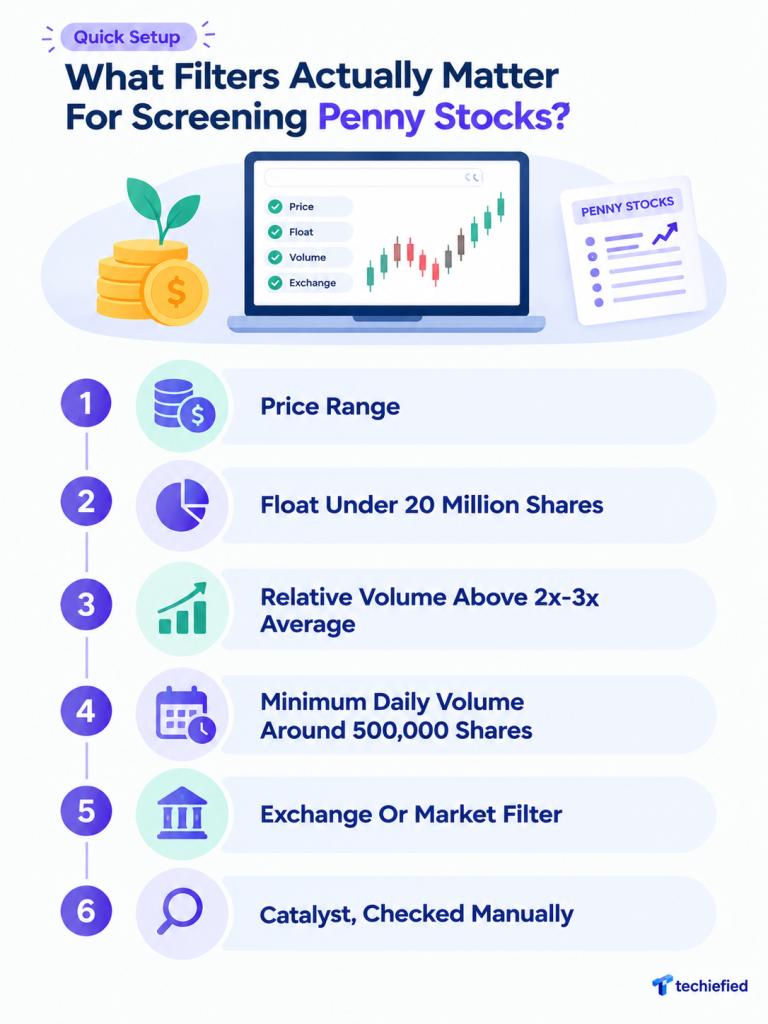
Five filters matter most:
- price,
- float,
- relative volume,
- exchange, and
- a manual catalyst check.
Most stock screeners handle the first four. None of them automate the fifth.
Price Range
Most traders define a penny stock as anything under $5 a share. Some tighten that to under $1 if they want stricter risk control. Set this filter first, since it decides which universe of stocks you’re even looking at.
Float Under 20 Million Shares
Float is the number of shares actually available to trade, not total shares outstanding. There’s no official cutoff, but 10 to 20 million is the range traders commonly use for penny stocks. A smaller float means less supply, so buying pressure moves the price faster.
Relative Volume Above 2x-3x Average
Relative volume, or RVOL, compares today’s volume to a stock’s normal average. A stock that usually trades 200,000 shares a day suddenly trading 2 million shares is telling you something changed.
Minimum Daily Volume Around 500,000 Shares
Below that, spreads widen and getting out of a position gets harder. This filter exists to keep you out of stocks you can get into but can’t easily exit.
Exchange Or Market Filter
Set this to isolate OTC names if that’s your focus, or exclude them if you only want NASDAQ and NYSE listings under $5.
Catalyst, Checked Manually
No free screener reliably flags this on its own. A catalyst is a real reason for a move: earnings, an FDA decision, a new SEC filing, a contract announcement. Without one, a volume spike is often just social media hype building toward a pump-and-dump.
Why Does Float Matter More Than Market Cap For Penny Stocks?
- Market cap tells you the size of a company.
- Float tells you how many shares are actually free to trade right now.
A stock can have a small market cap and still have a large float, which dampens volatility.
A stock with a float of 2 million shares. On the other hand, a stock can move 100% or more on a single catalyst.
Reason?
There simply aren’t many shares available to absorb buying demand. That’s why experienced penny stock traders check float before they check market cap.
Can I Get Real-Time Data On A Free Stock Screener?
Only if you pair the stock screener for penny stocks with a funded brokerage account. Without one, expect a delay ranging from 1 minute to 20 minutes.
Here’s how the delay breaks down by tool:
| Platform | Free tier data delay |
|---|---|
| Finviz | 1 minute (stocks); 15 minutes (futures/options) |
| Yahoo Finance | 15 to 20 minutes |
| TradingView | Real-time on free plan |
| Webull | Real-time with a funded account |
| Fidelity | Real-time with a funded account |
Finviz Elite ($39.50/month) removes the delay entirely and adds real-time quotes across the board.
But for most traders working off end-of-day or swing setups, the free 1-minute delay isn’t the problem. The delay matters most for penny stocks specifically, more than it does for large-cap names.
- A blue-chip stock rarely moves more than a fraction of a percent in a single minute.
- A thinly traded penny stock can move 20% or more in that same minute on a single large order.
That’s the gap a real-time feed closes and a delayed one doesn’t. Active traders also compare scanners built for intraday setups.
Stock Screener vs. Stock Broker: Which One Should I Actually Use to Trade?
A screener finds candidates. A broker executes the trade.
Finviz, TradingView, Yahoo Finance, and the OTC Markets screener will all show you what to look at. None of them place an order.
Once you find a stock worth watching, you still need a brokerage account to buy or sell it.
Some brokers fold a screener into the account itself, and the data upgrade only kicks in once you’re a client.
- Fidelity’s screener is free to anyone with an account and filters on more than 140 criteria, tied directly into its own research and analyst ratings.
- Webull’s screener is built mobile-first and covers price, market cap, volume, and momentum, enough for spotting small-cap setups, and it’s free once your account is funded.
In both cases, the free part is the account, not a standalone product.
- A standalone screener like Finviz is faster for casual research since it needs no account at all.
- A broker-based screener like Fidelity’s or Webull’s gets you real-time data and a shorter path from finding a stock to buying it.
However, you need to open and fund that account. Some brokers ask for no minimum deposit, which keeps the entry cost low.
In practice, most active traders for penny stocks end up using both. One screening tool for broad discovery and filtering, and their broker’s own screener or order screen for the live price they actually trade on.
If you need a live price to place a trade, get it from the broker’s order screen.
Bottom line Free Stock Screener For Penny Stocks
Pair a free filtering tool with the OTC Markets screener for compliance data, and let your broker’s order screen handle live pricing. That combination covers what a penny stock screener alone can’t: verified filings, real-time execution, and risk control on stocks that move fast enough to punish guesswork.
FAQs About Free Stock Screener For Penny Stocks
Q#1. What counts as a penny stock in 2026?
Most traders define a penny stock as anything trading under $5 a share. Some tighten that to under $1 for stricter risk control. The stock also typically has a small market cap, often under $300 million, and trades outside the major exchanges on OTC markets.
Q#2. Is Finviz good for penny stocks?
Yes, for filtering. Finviz has over 60 free filters covering price, volume, and float, with no account required.
Q#3. Do free screeners work for ETFs and mutual funds?
Yahoo Finance covers both directly with dedicated screeners. Fidelity also offers separate ETF and mutual fund screeners, but only to account holders.
Q#4. Which free screener has the most filters?
Fidelity’s account-based screener filters on more than 140 criteria. Among screeners that need no account at all, Finviz leads with 60-plus filters across descriptive, fundamental, and technical categories.
Q#5. Can I screen for penny stocks on mobile for free?
Yes. TradingView’s mobile app carries over most of its free filters. Webull’s screener was built mobile-first, covering price, volume, and momentum for anyone trading from a phone.
Q#6. Is it safe to trade penny stocks found through a free screener?
Screener data can lag actual company filings. Float and market tier status should be checked against the stock’s most recent SEC filing before you trade, not taken as final. Many traders also cap risk at 1% of their account on any single penny stock position, given how sharply these stocks can move.
