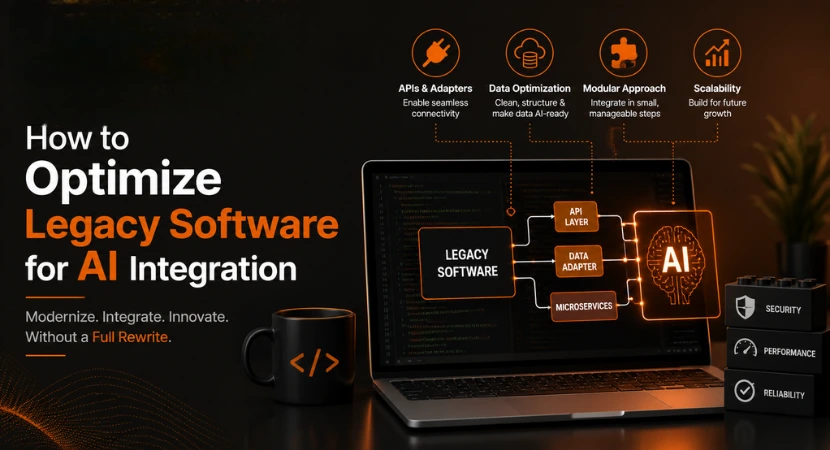
Many companies operate on legacy systems that are critical to their daily operations but are not designed for the modern AI era. The common reaction to this is often a full rewrite, which is a high risk and high cost venture. However, it is possible to introduce AI capabilities into an old system without tearing everything down.
The first step is to move from a monolithic architecture to a modular approach. Instead of modifying the core legacy code, you should build an AI wrapper or a middleware layer. This layer acts as a bridge between the old system and the AI model. By creating a set of clean APIs that expose the legacy data in a format the AI can understand, you can integrate AI functionality without altering the legacy codebase itself.
Data accessibility is the second major hurdle. Legacy systems often store data in silos or in formats that are not AI ready. To make this data useful, you need to implement an asynchronous data pipeline. This involves extracting data from the legacy database, cleaning it, and moving it to a vector database or a modern data lake. This allows the AI to have a context window that is grounded in the real world data of the company, without putting a load on the legacy production database.
Once the data pipeline is part of the architecture, you can begin integrating AI features based on a specific business outcome. Rather than trying to automate everything, focus on a single, high impact area such as automated customer support or internal knowledge retrieval. This approach allows you to test the and refine the AI implementation while keeping the rest of the legacy system stable.
For those looking to scale these integrations, we have written about the process of moving AI from a proof of concept to production grade in more detail here: https://jaspero.co/blog/beyond-the-poc-a-framework-for-scaling-and-maintaining-production-grade-ai-syste
Ultimately, the goal is to optimize the legacy system to act as a data provider for the AI, rather than trying to force the AI into the legacy code. By focusing on the middleware layer and the data pipeline, you can unlock the AI potential of your existing software while avoiding the risks associated with a full system rewrite.
