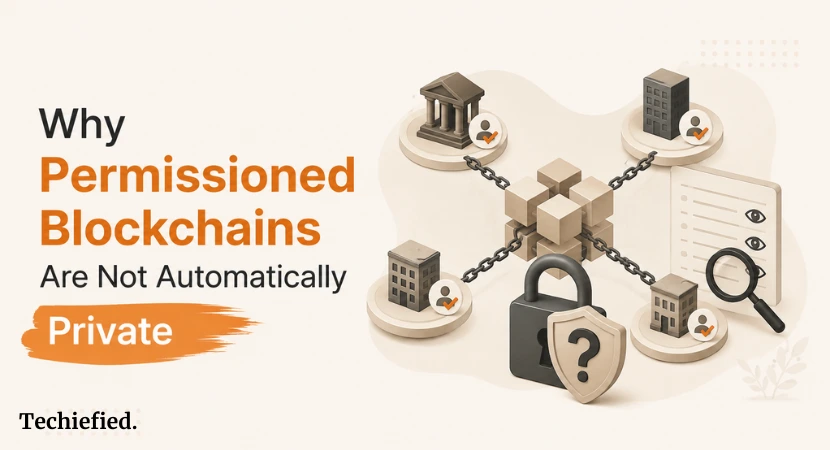
A permissioned blockchain can keep unknown participants outside a network. That is valuable when banks need controlled membership, approved validators, and accountable operators. Yet restricted entry does not guarantee confidentiality for the organizations and people already inside.
Because permissioning determines who may join, run a node, or validate transactions. Privacy layer determines what each approved participant may see. Treating these as the same control can leave sensitive balances, transaction patterns, contract activity, and business relationships visible across a consortium.
Permissioning Controls Membership
Think of a permissioned blockchain as a building with a guarded entrance. The guard checks every name and admits only approved visitors. Once inside, however, those visitors may still find open record rooms, shared screens, and copies of documents in several offices.
A consortium blockchain creates a similar challenge because verification depends on shared records. An approved organization running a full node may receive a complete copy of the ledger. This replication helps participants agree on transaction history without relying on one central record keeper. It can also allow one member to study the activity of another.
That exposure is not necessarily a technical failure. It is often the expected behavior of the network. The privacy gap appears when institutions assume that approved membership also limits visibility.
Data Can Be Exposed Beyond the Node
Nodes are only one part of the blockchain environment. Users and applications normally reach ledger data through RPC endpoints, block explorers, APIs, indexers, dashboards, and smart contract event feeds.
Each tool creates another path to information. A standard RPC endpoint may answer queries about many accounts and transactions. An explorer may present the same view to every authenticated user. An indexer can also copy the full ledger into a searchable database.
This means a vendor who was hired to support one payment application now gains access to unrelated treasury activity. An employee investigating a failed transaction might see customer records beyond the needs of that role. No external attack is required for all these to happen. The access design itself can reveal too much.
Privacy Requires Four Distinct Layers
Application privacy controls how people and systems interact with blockchain data. Role-based access, private RPC gateways, scoped explorer views, contract permissions, and filtered event feeds can limit each user to relevant information. Audit logs can record who accessed what.
Network privacy controls who may operate infrastructure and participate in consensus. Validator approval, node onboarding, peer rules, mutual TLS, and private connectivity help keep unauthorized parties out. These controls are essential, but they do not stop approved consortium members from viewing data replicated to their nodes.
Asset privacy protects the financial details within a transaction. These may include balances, transfer amounts, asset types, and counterparty identities. Zero-knowledge proofs can let a network verify that a transaction follows agreed rules without revealing every underlying value. Selective disclosure can still provide authorized auditors, regulators, or compliance teams with the evidence they require.
Ledger privacy protects business processes and contract state. Hiding a payment amount may not be enough if other members can see which institutions interacted, which contract they used, and when each step occurred. Private sub-ledgers, bilateral workflows, private domains, or privacy-scoped execution can restrict that wider context to the relevant parties.
The Right Design Depends on the Use Case
Not every institution needs every privacy layer. A blockchain operated entirely within one bank may rely mainly on strong application access and network controls. But in a shared tokenized deposit network run by a bank, the risk profile is different because participating institutions may need to validate the network without revealing balances and payment histories to competitors.
This is true for other use cases as well. A consortium handling settlement, collateral, or other sensitive workflows may need all four layers. The right question is then not whether the blockchain is permissioned. It is which participants can access each category of information through every part of the architecture.
Privacy Must Be Designed Deliberately
Permissioned infrastructure provides a strong foundation for institutional blockchain networks. It establishes controlled participation and accountable operation. Confidentiality requires another set of design decisions.
Banks should map who can query the chain, who receives ledger copies, which transaction details are exposed, and which workflows reveal commercially sensitive metadata. A modular, stack agnostic privacy layer brings in this kind of layered approach through modular controls for access governance, private data access, confidential assets, selective disclosure, and private execution across supported blockchain environments.
We will wrap this saying, a permissioned blockchain is just an entry gate. Privacy needs a few more walls.
