
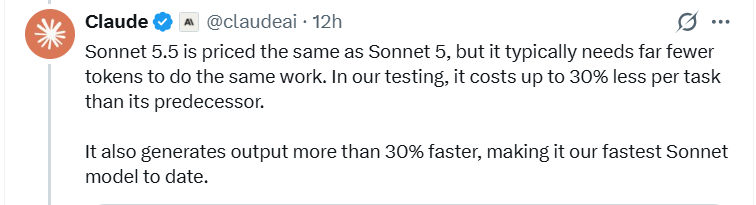
Anthropic released Claude Sonnet 5.5 on September 28, 2026. It is the second model in the Claude 5.5 family. The company calls it a clear upgrade over Sonnet 5. It runs more than 30 percent faster. It costs up to 30 percent less for most work.
Claude Sonnet 5.5 pricing stays the same at $2 per million input tokens and $10 per million output tokens.
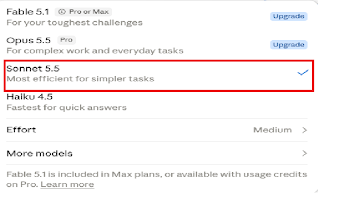
Sonnet 5.5 sits between the more powerful Claude version history’s Opus 5.5 and the upcoming Haiku 5.5. It targets everyday tasks that need speed and lower cost.
You can use it now on Claude.ai, the Claude Platform, Claude Code, Amazon Bedrock, Google Cloud, and Microsoft Foundry.
What Is Claude Sonnet 5.5 and How Does It Improve on Sonnet 5?
Claude Sonnet 5.5 is Anthropic’s mid-tier model. The model ID is claude-sonnet-5-5. It has a 1 million token context window and can output up to 128,000 tokens.
Knowledge cutoff of Claude Sonnet 5.5 is June 2026.
Claude Sonnet 5.5 improves on Sonnet 5 in three main areas.
- First, performance. On Terminal-Bench 4.0, an agentic coding test, Sonnet 5.5 scores 70.6 percent. Sonnet 5 scored 10.3 percent. In some settings it also edges out Opus 5.5, which scored 66.4 percent at its highest effort level.
- Second, speed. The model generates outputs more than 30 percent faster than Sonnet 5. Anthropic calls it the fastest Sonnet so far.
- Third, efficiency. It needs fewer tokens to finish the same work. That drops the real cost by up to 30 percent even though the per-token price has not changed. Cache reads cost $0.20 per million tokens.
Sonnet 5.5 is the first Sonnet model to ship with the same cyber safeguards Anthropic uses on its top models like Fable. It includes protections against distillation attacks.
Claude Sonnet 5.5 Release: Key Features and Technical Specifications
Pricing matches Sonnet 5: $2 input and $10 output per million tokens.
Thinking is on by default. Developers can turn off the upfront thinking step with the between_tools setting. Default effort on the Platform is high. Claude apps start at medium.
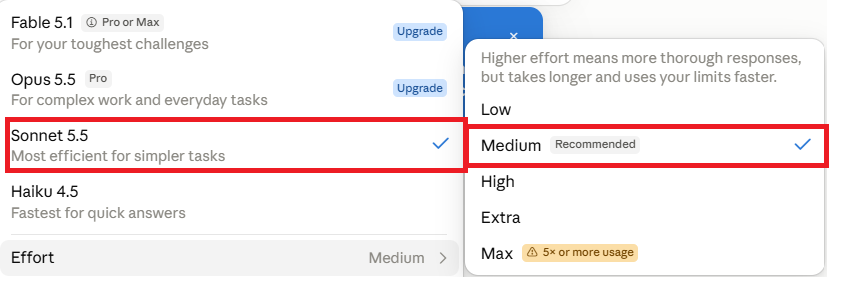
Anthropic recommends Sonnet 5.5 for tasks where you want a balance of quality, speed, and cost.
For large or complex projects they still suggest starting with Opus 5.5. Cranking Sonnet to maximum effort can reduce some of that balance.
The Sonnet 5.5 model by Claude is available on Pro and Max, while Team users received a usage reset. They can apply it any time before October 22, 2026.
Bug Fixing and Everyday Coding With Claude Sonnet 5.5
Sonnet 5.5 handles well-scoped coding work such as fixing bugs and iterating on features. In Claude Code it completes these tasks with less token use and higher speed than Sonnet 5.
One public demo shows it fixing a bug while running 30 percent faster and using 30 percent less. Developers note it reviews code more carefully and keeps edits small enough to check. Getting the most out of it still comes down to prompting basics.
Claude Sonnet 5.5 Multi-Step Tool Use and Agentic Tasks
The model runs multi-step tool sequences more efficiently. In one demo it rakes a yard of leaves through repeated tool calls. It finished 24 seconds faster than Sonnet 5 and used 6,000 fewer tokens.
Users get roughly 30 percent more tasks done in Claude Code compared with the previous Claude version.
Creative Content Generation With Claude Sonnet 5.5
Sonnet 5.5 can produce stylized explanations and visual content. One example asked it to explain gravity with an elastic sheet in ukiyo-e style. The new Claude AI model generated a full video response that matched the requested style without extra prompting.
Claude Sonnet 5.5 Combined Creative Design Work with Opus 5.5
Teams pair Sonnet 5.5 with Opus 5.5 for larger creative jobs. One project turned a GitHub repository into an explorable 3D post-Soviet block scene.
The work took about one hour and $55–57 in tokens. The result closely matched the requested environment of panel houses, yards, and playgrounds.
Claude Sonnet 5.5 Availability, Pricing, and Migration
Sonnet 5.5 is live on all major Claude surfaces and the listed cloud platforms. The price per token is unchanged from Sonnet 5, but lower token use makes most jobs cheaper.
Developers moving from Sonnet 5 should check the official migration guide. There are five breaking changes.
The main ones involve thinking controls and preserved thinking behavior. Anthropic published the full guide on the Claude Platform docs site.
How Claude Sonnet 5.5 Fits in the Claude 5.5 Family
Claude Opus 5.5 remains the flagship for complex work. Sonnet 5.5 by Claude is the faster and cheaper daily driver.
Haiku 5.5, aimed at high-volume and cost-sensitive jobs, is expected in the coming weeks.
Early independent checks place Sonnet 5.5 near the top of public mid-tier rankings. On one evaluation index it debuted second overall, just behind Opus 5.5, and helped Anthropic hold the top four spots.
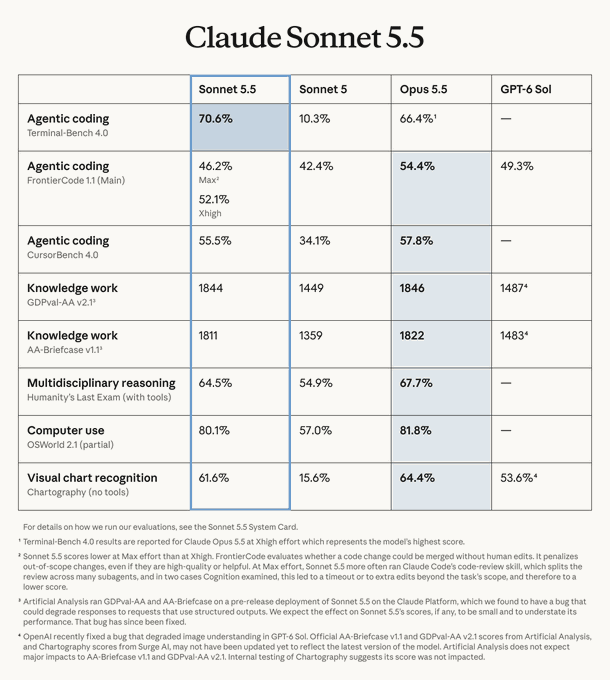
The release continues Anthropic’s pattern of shipping practical mid-tier models that focus on agentic coding and everyday knowledge work rather than pure scale.
Last Word
Claude Sonnet 5.5 release delivers measurable gains in speed and cost over Sonnet 5 while keeping the same list price. It scores well on agentic coding tests, finishes common tasks with fewer tokens, and is available now across Claude products and major clouds.
If you already use Sonnet, the migration path is documented. If you need a balance of quality and efficiency for coding, document work, or light agents, Sonnet 5.5 is the current option Anthropic recommends. Try it on Claude.ai or the Platform and review the migration notes before switching production workloads. New users may also want Anthropic’s free training resources.
