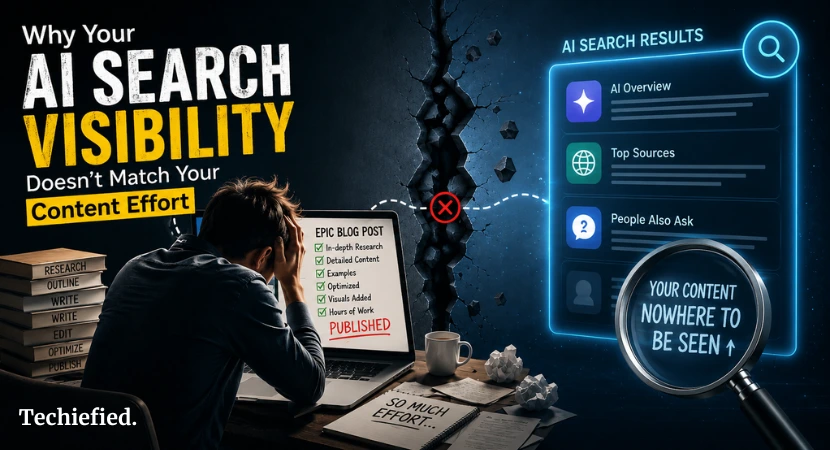
A founder asks ChatGPT two questions about his own product to check his AI search visibility.
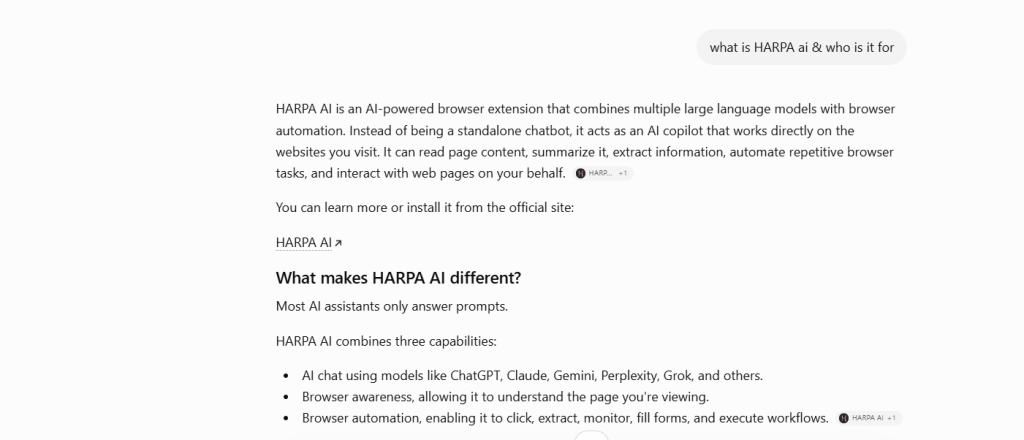
First: what is [brand] & who is it for. ChatGPT answers straight from his homepage. Clean, accurate, done.
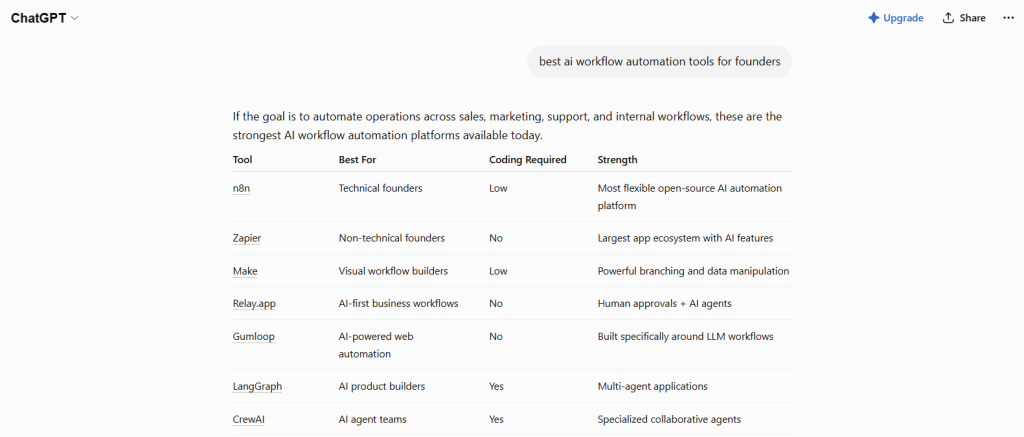
Second: best [category] tools for [his exact customer]. ChatGPT pulls three sources: a G2 page, a Reddit thread, & a roundup post. His site doesn’t show up once.
Same brand. Same AI engine. Two completely different answers. He checks his G2 profile. 8 reviews. His closest competitor has 47, & shows up in three of the cited sources where he shows up in zero.
Two years of blog content, and the gap that actually decides whether a buyer finds him isn’t on his blog at all. That’s what AI search visibility actually measures, and it’s not the same thing as content output.
Even great content doesn’t always translate into discoverability, just as other strategies for driving traffic to your website depend on channels beyond your own blog
Why Does ChatGPT Answer The Two Questions So Differently?
Because they’re two different retrieval jobs. A brand-name question has one obvious source: the brand’s own site, so ChatGPT goes there. A category question has no single source of truth, so the model leans on proof from other people instead.
Your homepage tells ChatGPT what you do. It doesn’t tell ChatGPT that anyone else likes you. That second piece is exactly what a buying-stage query is checking for, and it’s the piece your homepage was never built to supply.
How Do You Find Out Which Sources Are Driving Your AI Search Visibility?
Run your category query, not your brand name, in ChatGPT, Perplexity, & Google AI Overviews. Write down every source each one cites. Then run the same query for your two or three closest competitors & do the same.
Many teams also use AI workflow tools to monitor changes in search visibility across multiple AI platforms over time.
Another effective way to identify these gaps is by creating competitor comparison pages that address the same buying-stage questions AI systems often retrieve.
Put both lists side by side.
Wherever a competitor shows up & you don’t, that’s the actual gap in your AI search visibility. Most teams have never run this. Not because it’s hard. Because it doesn’t look like content work, even though it takes under an hour.
Which Public Platforms Tend To Show Up In That Gap?
The same names repeat across most categories: G2, Capterra, Reddit threads, Product Hunt, editorial roundups, analyst posts.
Google’s own moves in this space, like search profiles for creators, show how much control is shifting toward platforms rather than individual webs
These are the surfaces AI search visibility engines have already decided to trust for SaaS tool comparisons.
Similar patterns can also influence how other AI tools surface recommendations for software and services.
None of them belong to a content team. A well-written blog post can’t stand in for a listing on a site the model has already learned to check.
| Public Platforms | Who owns it |
|---|---|
| G2 / Capterra reviews | Customer Success |
| Reddit mentions | Community / Social |
| Editorial roundups | PR |
| Analyst posts | Analyst Relations |
| Website / blog | Content |
How Long Does That Source Map Actually Stay Accurate in AI Search Visibility?
Not long. Semrush tracked ChatGPT citations for three months after Google dropped its num=100 parameter in September 2025. In that window, PRNewswire, Forbes, & Medium gained citation share on ChatGPT.
Reddit & Wikipedia lost it, on the same platform, in the same window.
Reddit is the sharpest example. One study found its share of AI citations in ChatGPT dropped from roughly 60% to about 10% in a two-week span in September 2025.
Build your source map inside that window & you’d have spent a quarter chasing a platform that was already losing the model’s trust before your report was finished.
It gets messier across engines. Reddit leads citation share on most platforms, Fandom leads inside Google AI Mode, Perplexity leans toward LinkedIn, NIH, & G2, and Gemini responds more to traditional SEO signals than the others.
A map built from ChatGPT alone will point you at the wrong platform if your buyers are actually reading Perplexity. PR Newswire
Quarterly is the floor here, not a nice-to-have. AI search visibility isn’t a score you check once. It resets every few weeks whether you’re watching or not.
Why Isn’t AI Search Visibility Just A Content Team Problem?
Because ChatGPT or other AI search engines aren’t only reading your blog. They are reading what the rest of the internet says about you, & every one of those “rest of the internet” surfaces sits inside a different department.
If nobody owns the G2 review pipeline, reviews stay thin. If nobody’s seeding Reddit conversations, your brand never comes up there.
If PR isn’t pitching the roundups AI keeps citing, you stay off them. A content team can publish every week & still lose a category query, because none of those levers were ever theirs to pull.
What Should You Actually Do With The Gap List to Increase AI Search Visibility?
Assign an owner to each row on that table, not another writer. Thin G2 reviews are a Customer Success task. Missing Reddit mentions are a Community task. Absence from roundups is a PR pitch. None of these get fixed by adding a post to the content calendar.
Content still decides how ChatGPT describes your brand by name. It’s rarely what decides whether ChatGPT recommends you over the competitor sitting three sources ahead of you right now.
