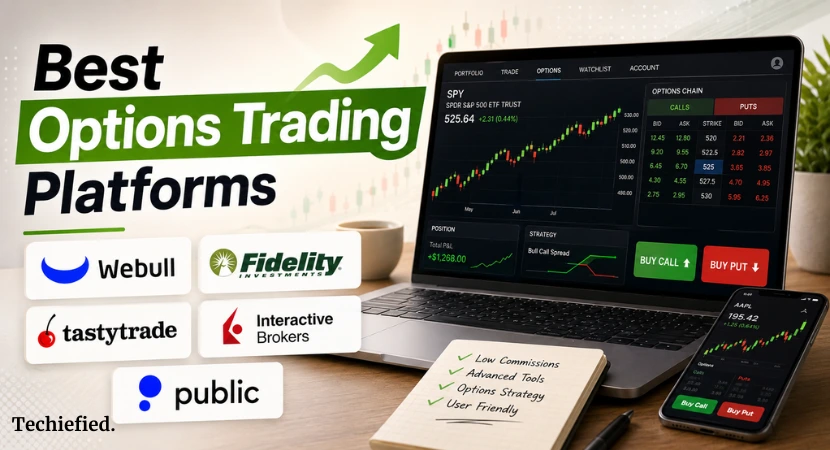
Webull is the best options trading platform for beginners in 2026 on cost: $0 per contract, real paper trading, and 4 approval levels to grow into. Fidelity and Charles Schwab’s thinkorswim are the picks NerdWallet and Investopedia lead with, built on education and branch access rather than fee savings. Robinhood is the simplest mobile app but now charges $0.50 per contract. Tastytrade fits once you’re ready for spreads.
In this blog we will find out other beginner-friendly best options trading apps in 2026. This guide covers US-regulated brokers, since options approval rules and fee structures are set by FINRA and the SEC.
How We Picked Beginners’ Options Trading Platforms
We checked per-contract fees, options approval requirements, paper trading access, education depth, and mobile app usability across 7 platforms. We pulled current fee schedules directly from each broker, not from older reviews still quoting outdated numbers.
Quick Comparison of Best Options Trading Platforms For Beginners in 2026
| Platform | Fee per contract | Approval levels | Paper trading | Best for |
|---|---|---|---|---|
| Webull | $0 | 4 levels | Yes | Best overall on cost |
| Fidelity | $0.65 | 4 levels | No | Best for branch access and no minimums |
| Robinhood | $0.50 ($0.35 with Gold) | 3 levels | No | Simplest mobile experience |
| Charles Schwab (thinkorswim) | $0.65 | 4 levels | Yes | Best for education |
| Tastytrade | $1.00 open, $0 close, $10 cap per leg | 3 levels | No | Growing into spreads |
| Interactive Brokers | $0.15 to $0.65 | 4 levels | Yes | Global access, low margin rates |
| SoFi | $0 | 3 levels | No | All-in-one beginner accounts |
| Public | $0 | 3 levels | No | Fractional options, rebate program |
Does Robinhood still charge $0 per contract for options in 2026?
No. Robinhood charges $0.50 per contract on standard accounts, $0.35 with Gold, since mid-2025. Webull, SoFi, Public, Firstrade, and moomoo still charge $0 per contract.
If you’ve read any comparison, apart from Techiefied’s, saying Robinhood is free, check the date. A lot of it hasn’t caught up.
Best Options Trading Platforms For Beginners
Here are the best options trading platforms for starters:
What is the best overall trading platform for beginners: Webull
Webull charges $0 per contract and gives you a real paper trading account with live market data. You get 4 approval levels, so there’s room to grow instead of hitting a wall at basic calls and puts.
Fidelity and Schwab are what NerdWallet and Investopedia actually lead with for beginners, and both have a case:
Fidelity has no account minimums and 200+ physical branches, Schwab’s thinkorswim carries Investopedia’s own “Best for Beginner Options Traders” award.
If you value in-person support or built-in education over saving $0.65 per contract, either beats Webull. If cost and self-directed practice matter more, Webull wins.
The research tools are thinner than Schwab’s. If you want deep options education built into the platform, Webull isn’t it.
$0/contract. 4 approval levels.
Paper trading: yes.
Best options trading platform for branch access and no minimums: Fidelity
Fidelity is NerdWallet’s 2026 Best-of Award winner for beginner brokers. It has no account minimums and a network of 200+ physical branches for in-person help.
Fidelity charges $0.65 per contract, no discount for volume, but has cut nearly every other account fee, including transfer and closure fees.
Fidelity has no paper trading account, so you learn order mechanics live rather than in a simulator.
$0.65/contract. 4 approval levels.
Paper trading: no.
What is the Best Options trading platform for learning: Charles Schwab (thinkorswim)
thinkorswim has the deepest options education of any platform on this list: built-in courses, live daily shows, and a paper trading environment that mirrors real execution. Schwab’s own research found traders who used in-platform education were 40% more likely to still be trading after 12 months.
The interface has a steep learning curve. New traders sometimes need a few sessions just to find the option chain.
$0.65/contract. 4 approval levels.
Paper trading: yes.
Best zero-fee option trading platform: Public
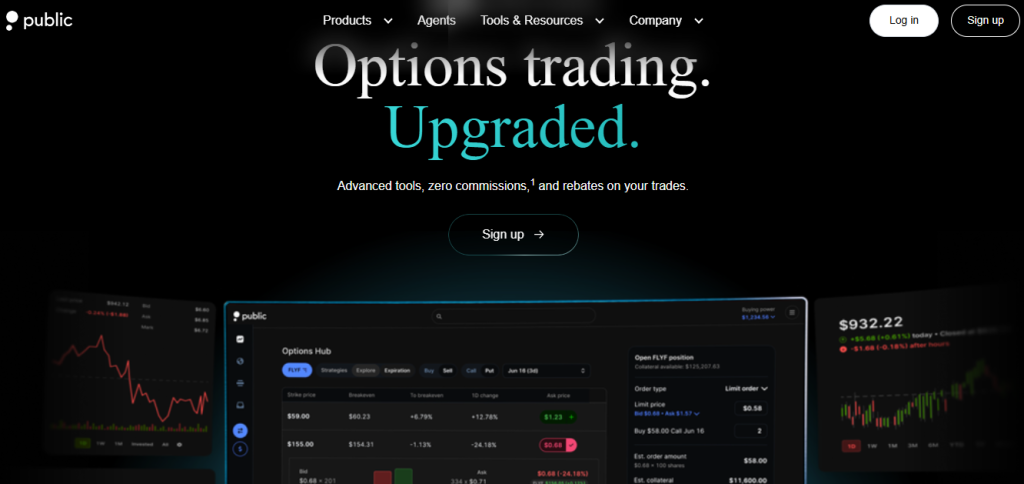
Public charges $0 per contract and no per-trade commission, with a rebate program that pays you on qualifying trades. It supports fractional options, so smaller accounts can get exposure without buying a full contract.
Public has fewer account types and less advanced charting than full-service brokers like Schwab or Interactive Brokers.
$0/contract. 3 approval levels.
Paper trading: no.
Best option trading platform for growing into advanced strategies: Tastytrade
Tastytrade charges $1 to open a contract and $0 to close, capped at $10 per leg, which rewards traders who scale into multi-leg positions like spreads and iron condors. Tastylive’s education content, built by the founders of thinkorswim, is some of the strongest options-specific teaching available.
There’s no paper trading account. Beginners often find the platform assumes more options knowledge than they have on day one.
$1/contract open, $0 close ($10 cap per leg). 3 approval levels.
Paper trading: no.
Best option trading platform for global and multi-asset beginners: Interactive Brokers Lite
IBKR Lite gives you access to over 150 markets and options fees as low as $0.15 per contract, with margin rates well below Schwab or Fidelity. It’s the strongest choice if you plan to trade beyond US stocks and options.
For traders who also manage finances across countries, comparing banking options for people who live and work internationally can be useful alongside choosing a broker.
The platform is built for volume and global reach, not hand-holding. Beginners looking for guided education will find less of it here than at Schwab or Webull.
$0.15 to $0.65/contract. 4 approval levels.
Paper trading: yes.
What are options trading approval levels and why do beginners get blocked?
Options trading approval levels are tiers brokers use to control which strategies you can trade.
FINRA’s Know Your Customer rule requires brokers to assess your experience and finances before letting you use leveraged instruments, so every broker runs an approval process before your first options trade goes through.
Most brokers use 3 to 4 levels:
Level 1: covered calls and cash-secured puts. You already own the stock or hold the cash to back the trade, so risk is limited.
Level 2: buying calls and puts outright. This is where most beginners land after approval.
Level 3: spreads and other strategies that need margin. Brokers usually require a funded margin account and some trading history first.
Level 4: uncovered (naked) options, where losses aren’t capped. Brokers reserve this for accounts with significant capital and experience.
The names and requirements aren’t standardized. Tastytrade calls its 3 tiers Limited, Basic, and The Works.
Schwab, Fidelity, and Interactive Brokers use their own labels and criteria.
A Level 2 at one broker doesn’t guarantee Level 2 at another; if you switch brokers, you reapply and your new broker makes its own call.
This is the actual bottleneck for most beginners; not platform choice, but getting approved for the strategies they want to use.
Check a broker’s approval criteria before you open an account, not after you’ve funded it and tried to place your first trade.
Does Paper Trading Actually Help Before Trading Real Money?
Paper trading lets you place trades with fake money on live market data. It helps you learn order types, assignment risk, and how fast an option’s price moves before anything real is on the line.
Thinkorswim has the strongest paper trading setup on this list. It’s a full simulated account (paperMoney) that mirrors live execution and order flow.
Tastytrade has no paper trading account. Its account types are limited to individual, retirement, joint, business, and international accounts, none of them a simulated one. Instead, Tastytrade offers a historical backtesting tool, which shows how a strategy would have performed on past data but doesn’t simulate live order fills or real-time decision-making.
Retail options trading carries real failure risk. Independent studies on retail traders put loss rates at 80% to 90% over time. It is largely from time decay, overleveraging, and lack of an exit plan; the exact factors paper trading is built to expose before they cost you money.
What Do Reddit Say About Best Options Trading Platforms?
Thinkorswim gets respect from experienced traders for its depth, but beginners on forums consistently describe the interface as overwhelming for a first trade. New users report spending multiple sessions just locating the option chain before placing anything.
Robinhood remains the default on-ramp for first-time options traders despite the 2025 fee change. Its simplicity is still the draw, even though it’s no longer the cheapest choice.
Traders on ultra-low-fee platforms raise execution quality complaints: order fills that lag or land at worse prices than the quoted bid-ask spread. The concern is that a $0 commission doesn’t matter if the fill price costs you more than the fee would have.
That makes the underlying infrastructure supporting modern trading platforms just as important as the headline commission.
What Are The Common Options Trading Mistakes Beginners Make
- Ignoring time decay. Options lose value every day that passes, whether the stock moves or not.
- Overleveraging. Sizing a position for maximum contracts instead of maximum risk you can absorb.
- No exit plan. Entering a trade without deciding in advance when to take profit or cut a loss.
- Chasing $0 fees over execution quality. A free trade filled at a worse price can cost more than a $0.65 commission.
- Skipping paper trading. Placing a first real trade without ever testing order types or assignment mechanics in a simulator.
Bottom line
Webull is the best overall pick for options trading platforms for beginners in 2026: $0 per contract, real paper trading, and room to grow through 4 approval levels. It also makes a useful starting point for investors comparing different financial market platforms. Robinhood still works if simplicity matters more to you than cost, but it’s no longer free at $0.50 per contract. Schwab’s thinkorswim is worth the steeper learning curve if education is the priority, and Tastytrade makes sense once you’re ready to trade spreads instead of single legs.
Check any broker’s current fee schedule directly before you open an account. Fee structures and regulations, including the PDT rule change in June 2026, have moved fast enough that older comparisons are already out of date.
FAQs on Best Options Trading Platforms
Q#1. What is the best options trading platform for beginners in 2026?
Webull is the strongest overall pick: $0 per contract, 4 approval levels, and a real paper trading account with live data. Robinhood is simpler to use but now costs $0.50 per contract.
Q#2. Does Robinhood still charge $0 for options trading?
No. Robinhood charges $0.50 per contract on standard accounts, $0.35 with Gold, since mid-2025. Webull, SoFi, Public, Firstrade, and moomoo remain $0 per contract.
Q#3. Do I need $25,000 to trade options?
Not anymore. The FINRA Pattern Day Trader rule, which required $25,000 in equity to day trade actively, was eliminated as of June 4, 2026. It’s replaced by intraday margin standards tied to your actual market exposure, not a fixed dollar minimum. Some brokers have until October 2027 to fully implement the change, so check your specific platform’s current policy.
Q#4. Is paper trading necessary before trading options with real money?
It’s not required by any broker, but it lets you test order types and assignment mechanics before risking capital. Thinkorswim has the strongest simulated environment. Tastytrade has no paper trading account at all, only historical backtesting.
Q#5. Which platform has the best options education for beginners?
Charles Schwab’s thinkorswim has the deepest built-in education: courses, live daily shows, and a simulated trading account. Tastytrade’s tastylive content is also strong but assumes more prior knowledge.
