Cybercrime is on track to cost more than $10 trillion. Over 80% of attacks start with stolen or hacked credentials. DataIntelo puts the identity and access management market at $21.4 billion by 2025, rising to $62.8 billion by 2034, a 12.7% CAGR from 2026 to 2034.
Companies used to trust anyone connected to the corporate network. That assumption broke once cloud tools, hybrid work, and personal devices entered the picture. A modern business runs on 250 cloud products on average, and a single employee touches 10 to 15 systems in a week.
Each login is a point where weak authentication opens the door.
IAM builds a digital identity for every employee, contractor, supplier, and client, then grants access based on their actual role. Not blanket access to everything. Companies now protect individual identities, not just the network edge.
Main features that strengthen security
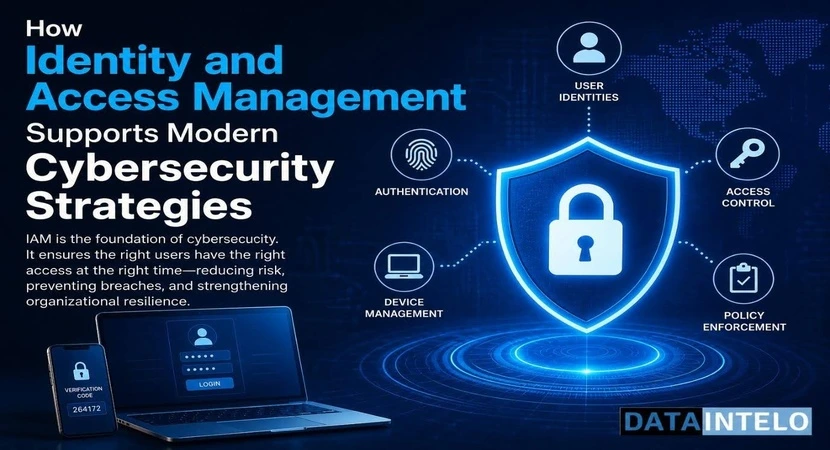
IAM combines several technologies and policies to cut the risk of cyberattacks. Together, they give companies more control over digital services and cut down manual work.
Core IAM functions:
- User authentication through passwords, biometrics, or multi-factor authentication
- Role-based access, so users see only what their job requires
- Single sign-on, so users log in once and reach multiple apps
- Automated provisioning and deprovisioning when employees join or leave
- Continuous monitoring of login patterns to catch unusual activity
Multi-factor authentication alone blocks more than 99% of automated credential attacks, according to industry reports. Few controls deliver that kind of return.
IAM drives the Zero-trust model
Zero trust assumes no user, device, or app is safe by default. IAM checks a user’s identity before granting access, and it factors in device condition, location, login time, and behavior.
Say an employee has logged in from Mumbai for years, then suddenly tries to access the system from another country at 2 a.m. The system can block that request.
Around 70% of large companies have already rolled out zero trust or are in the process.
IAM handles compliance and oversight
Data protection rules keep getting stricter. Companies need to show who accessed sensitive data, when, and whether the right controls were in place.
IAM keeps full authentication logs, access histories, and permission records, so audits don’t start from scratch.
Automation also cuts the manual work compliance teams used to handle by hand.
| IAM Capability | Cybersecurity Benefit | Operational Impact |
| Multi-factor authentication | Stronger identity verification | Lower account compromise rates |
| Role-based access control | Limits unauthorized data exposure | Improved permission management |
| Single Sign-On | Fewer password-related vulnerabilities | Faster employee access |
| Access logging | Better incident investigations | Simplified compliance reporting |
| Automated provisioning | Reduces orphaned accounts | Improved operational efficiency |
Interestingly enough, organizations with already developed identity management systems report that time taken to prepare for audits was reduced by up to 40% due to the automation of access management processes.
Cloud adoption makes IAM harder to skip
Cloud computing multiplied the number of identities companies have to track. Employees move between SaaS tools, internal apps, mobile devices, and cloud services throughout the day.
As these environments become more complex, the digital infrastructure behind modern businesses also needs to support secure, reliable access across applications and services.
Over 90% of companies now use some form of cloud computing. Each new cloud service adds its own login, its own user profile, its own set of permissions to manage.
IAM centralizes that. Security teams apply one consistent set of rules across every application, no matter where it runs.
Wrap Up
IAM started as an administrative task. It’s now a core part of cybersecurity strategy. As companies keep moving to the cloud and supporting remote work, identity has taken over as the security perimeter.
Strong authentication, least-privilege access, zero trust checks, compliance support, and continuous monitoring all work together in IAM to cut cyber risk and protect critical systems. Credential-based attacks aren’t slowing down, and identity management will stay central to how companies defend themselves in the years ahead.
