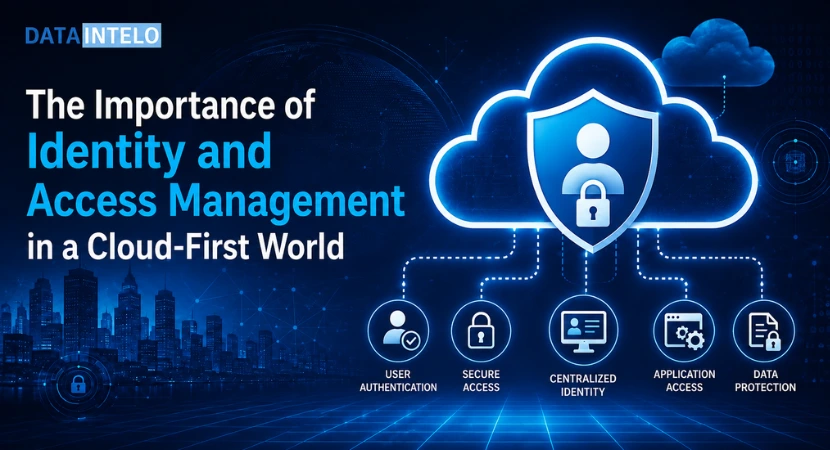
Cloud computing has turned into the basis for modern business activities. Nowadays, large numbers of organizations use cloud platforms to control their programs, save business information, and promote remote labor.
The estimations of experts show that over 90% of enterprises have recourse to several services in the cloud while the average organization supervises dozens of cloud software in different departments. Due to the increase in cloud adoption, achieving control over upcoming digital resources was turned into one of the most important priorities in cybersecurity.
Many organizations now depend on cloud-based services, which leads to the increase in demand for identity and access management (IAM) solutions. Data Intelo reports that the market for IAM is expected to be valued at $21.4 billion in 2025, and will in the following years grow to $62.8 billion. The growth rate of the market will amount to 12.7% in the period from 2026 to 2034.
IAM is a system developed for identity verification and granting access to a network, apps, and information. IAM differs from classic security solutions in such a way that while traditional security providers safeguard their networks’ integrity, IAM ensures that every action involving a certain user is registered. In a situation when users are people and software, proper management of users helps to avoid possible risks.
Why Identity Has Become the New Security Perimeter
For a long time, traditional cybersecurity based its safeguards on the security of the network border. The advent of cloud technology, however, has pushed applications and valuable data out of the on-site perimeter into cloud infrastructure. As more applications and workloads move into the cloud, reliable digital infrastructure becomes increasingly important to keep these systems secure and available.
According to some estimates, nearly 70% of workloads are processed in the cloud and hybrid work becomes more and more widespread throughout the world.
This change has caused the transformation of digital identities into the new security perimeter. Each employee account, customer profile, administrator credential, and machine identity becomes a potential entry point to resources. Cybersecurity studies show that more than 80% of data breaches are committed through the use of compromised or stolen credentials that makes identity protection crucial.
Unlike trusted users, IAM verifies an identity each time it allows him/her access to resources. This method of identity verification allows minimizing the risk of unauthorized access to the resources of a company and makes supporting flexible working conditions possible.
Key Elements of Identity and Access Management
Identity and Access Management is a group of technologies that works together to safeguard digital environments. Most organizations apply multiple IAM solutions to achieve their objectives in keeping sensitive data safe.
- Authentication is the process that determines if a user is a person they claim to be by using passwords, biometrics, security keys, or multi-factor system.
- Authorization is the process by which a system determines what applications, files, or systems the user is allowed to use according to the permissions set beforehand.
- Single Sign-On (SSO) is a system that allows access to multiple applications through one login, thus attaining password fatigue alleviation and boosting employee performance.
- Multi-Factor Authentication (MFA) allows the establishment of several levels of authentication, thus making it impossible for unauthorized people to get access to the system even in case of having passwords.
- Privileged Access Management (PAM) is a way to limit the access of very elevated levels of administrative accounts that become one of the main targets for hackers.
Applying MFA, companies report that more than 99 percent of automated hacking attempts have failed, which makes MFA one of the most productive methods of securing identity.
IAM Problems in Multi-Cloud Settings
Many businesses do not rely on a single cloud provider. Surveys show nearly 76% of organizations operate in a range of cloud cloud services, which creates a lot of complexity.
Various cloud environments may also utilize different authentication programs, user directories, and security policies. In the absence of centralized identity management, organizations may face a host of challenges.
| IAM Challenge | Potential Business Impact | Identity Management Benefit |
| Multiple user accounts | Password fatigue and weak credentials | Centralized authentication |
| Excessive user permissions | Higher insider security risks | Role-based access control |
| Delayed account removal | Unauthorized access after employee departures | Automated identity lifecycle management |
| Fragmented security policies | Inconsistent compliance | Unified access governance |
| Limited activity monitoring | Delayed threat detection | Continuous identity monitoring |
Centralized IAM solutions help make identity governance easy as they provide standard authentication policies across the various cloud applications they use.
The Role of IAM in Regulatory Compliance
The increasing importance of regulatory compliance and subsequent processing of large amounts of private customer and business data raises the need for businesses to comply with privacy legislation that requires them to establish security controls regarding access to sensitive data.
IAM helps organizations to be compliant by ensuring the availability of all access records, implementation of minimum privilege principle, and support of regular access assessments. Companies that have robust access governance can save time on audit preparations by 30-40% due to automated reporting and centralized access logging.
Moreover, IAM aids the processes of employee onboarding and offboarding. Automated provisioning enables fast provision of required access for newly-hired employees while immediate deactivation of accounts minimizes the risk involved in the turnover process.
Zero Trust Security and The Future of Identity Protection
The advent of Zero Trust security has enhanced the significance of IAM. Instead of trusting users upon their initial login, Zero Trust checks for identity, device state, location, and user conduct at all times.
According to experts, the implementation of Zero Trust will cost the organization less than the traditional methods when dealing with breaches. Continuous authentication, dynamic access rights, and behavioral analysis allow for the detection of unusual occurrences beforehand.
Artificial Intelligence is helping IAM evolve by detecting unusual user activity, improbable travel activity and unreasonable attempts to increase privileges. As AI becomes part of existing security environments, organizations also need to consider how older systems can support modern AI capabilities.
Such smart technologies facilitate threat detection and reduce false alerts.
The emergence of the cloud ecosystem has made machine identity gain importance too. Current companies manage many machine accounts like applications, APIs, containers and devices. So, protecting these non-human identities is a vital part of IAM.
Final Thoughts
The role of Identity and Access Management has transformed in the last few years from performing auxiliary IT functions to becoming one of the most important aspects of modern cybersecurity. As organizations shift to a cloud-first approach, digital identities are becoming a focal point of security initiatives, gradually replacing conventional lines of defense against cyberthreats.
Providing satisfactory IAM solutions leads to better means of authentication, permission management, compliance facilitation, and protection against credential-based attacks. This role is achieved with the help of multi-factor authentication, single sign-on, privileged access, and automated identity governance.
With the ever-increasing use of cloud technology, remote work and digital transformation, the significance of effective Identity and Access Management will only grow in the future.
