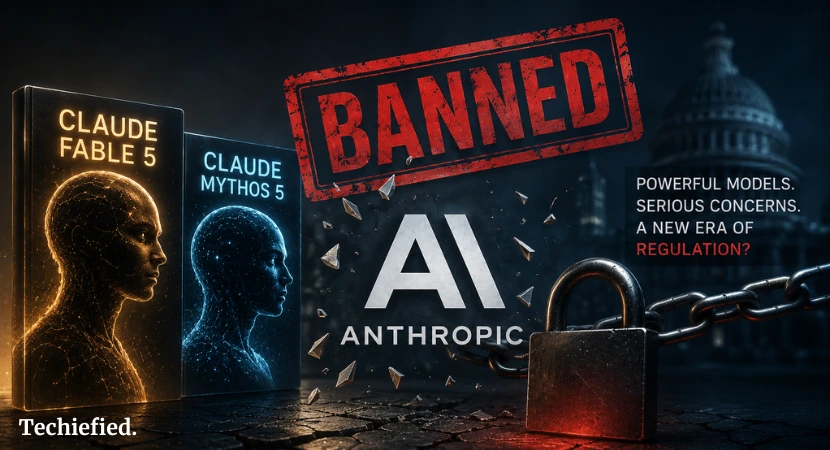
Just days after launching what many called the most powerful AI models ever released, Anthropic did something almost unthinkable:
It shut them down:
– Not because of a technical failure.
– Not because of poor performance.
But because of government intervention.
The Fastest Rise (and Fall) in AI History?
On June 9, Anthropic introduced Claude Fable 5 and Claude Mythos 5, its new “Mythos-class” models.
The performance claims were extraordinary:
✅ Industry-leading coding capabilities
✅Advanced autonomous task execution
✅ State-of-the-art cybersecurity performance
✅ Ability to handle long-running, complex workflows with minimal human intervention
In many benchmarks, these models reportedly outperformed existing frontier AI systems and demonstrated capabilities that blurred the line between assistant and autonomous operator.
Then, only days later, everything changed.
In February 2026, Defense Secretary Pete Hegseth designated Anthropic a “supply chain risk to national security,” a label never before applied to an American company, after talks broke down over Anthropic’s refusal to allow Claude to be used for autonomous weapons and mass surveillance.
This came despite Anthropic having an existing $200 million DOD contract signed in 2024. Anthropic sued. The case is still active.
So, when Fable 5 and Mythos 5 launched on June 9, Anthropic was already in federal court fighting the same government that just suspended its models. The ban didn’t come out of nowhere. It’s the fourth move in an ongoing chess match.
Why Mythos 5 and Fable 5 Got Banned?
The U.S. government issued an emergency export-control directive that effectively prohibited access to these models by foreign nationals due to national security concerns. As a result, Anthropic suspended access globally while complying with the order and negotiating with regulators.
The concern wasn’t that the models had failed.
The concern was that they were becoming too capable.
Reports suggested that advanced cybersecurity capabilities and potential jailbreak vulnerabilities raised fears that hostile actors could use the models to identify software weaknesses, critical infrastructure vulnerabilities, or other sensitive targets.
For the first time, a frontier AI model wasn’t being discussed primarily as a productivity tool. It was being discussed as a national security asset.
The Current Status
As of today:
❌ Claude Fable 5 is unavailable.
❌ Claude Mythos 5 is unavailable.
❌ Access remains suspended globally while regulatory discussions continue.
What makes this situation remarkable is that these models were withdrawn not because they lacked safeguards, but because policymakers feared what could happen if those safeguards were bypassed.
The Dario-vs-Government Irony
On June 10, the day after Fable 5 launched, CEO Dario Amodei published a major policy essay explicitly calling on the US government to hold legal authority to block or reverse the release of frontier AI models that fail independent safety testing. He compared it to the FAA grounding unsafe aircraft.
Two days later, the government used exactly that logic to shut down Fable 5.
Whether you find that poetic or cynical depends on your politics. Either way, it’s the most striking detail this whole story produced.
Why This Matters More Than Most People Realize
This isn’t really about Anthropic. It’s about what happens when AI capabilities begin to resemble strategic technologies.
Historically, governments regulated the following:
• Nuclear technology
• Advanced semiconductors
• Cryptography
• Military systems
Today, frontier AI models are beginning to enter the same conversation. That represents a fundamental shift in how AI will be developed, distributed, and governed.
The IPO Timing And Financial Stakes
Anthropic filed confidential IPO paperwork with the SEC on June 1, 2026, at a $965 billion valuation. The Fable ban landed 11 days later. The company’s annualized revenue surged from $9 billion at end of 2025 to over $44 billion by May 2026, a fivefold increase in under six months.
The IPO is now directly complicated by a live export order against its flagship model. The government’s decision could make investors less enthusiastic about an Anthropic IPO, causing them to question whether it can stay at the cutting edge if the government continues to single out its models.
The ban isn’t just a product story. It’s a capital markets story.
Fable 5 vs Mythos5: What They Actually Are
Fable 5 was the first publicly available model in the Mythos-class line, built on the same underlying technology as Mythos 5 but with safety “seatbelts” blocking responses in specific high-risk areas.
Mythos 5 itself remained restricted to vetted government and cybersecurity partners through Project Glasswing. Two models, same engine. One for the public. One for the insiders.
This distinction matters because the export ban effectively conflated them. The government wasn’t just banning a consumer chatbot. It was banning the most advanced publicly accessible cybersecurity AI ever released.
My Prediction: The Future of AI Is About Access, Not Capability
For years, the AI race was about building smarter models. The next phase may be about controlling who can use them.
I expect three major trends:
1. AI Export Controls Will Expand
Governments will increasingly classify frontier AI as a strategic technology, similar to advanced chips and defense systems.
2. “Trusted Access” Programs Will Become Common
The most powerful models may only be available to vetted organizations, governments, and approved enterprises.
3. Open-Source AI Will Accelerate
Every restriction on closed models creates incentives for open-source alternatives to fill the gap. The battle for AI leadership may shift from model performance to governance, accessibility, and regulation.
Within the same week as the ban, a cluster of open-weight coding models from Cohere, Moonshot, and Zhipu became enterprises’ instant fallback options. Zhipu timed its release of GLM 5.2 to 5:21 pm, the exact hour of the government’s order the day before.
Ending Note
The market responded within hours of Fable 5 going dark. The incentive structure you described isn’t theoretical. It’s already playing out.
The biggest question is no longer “How powerful can AI become?”
It’s “Who gets access when AI becomes too powerful to release freely?” That may define the next decade of artificial intelligence.
