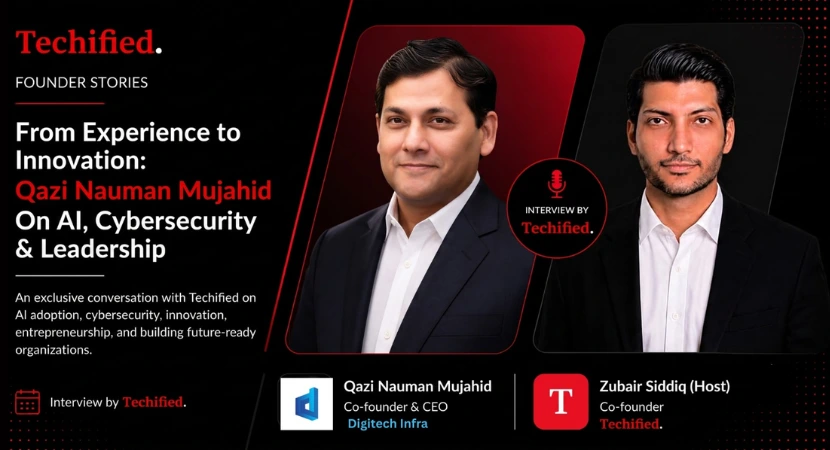
Pakistan’s technology sector talks often about AI adoption, yet far fewer organizations are building with it. Mr. Qazi Nauman Mujahid has spent around 35 years in the IT industry watching that gap from close range, beginning his career at PTCL, where he spent nearly 16 years, before founding Digitech Infra Pvt. Ltd. in 2018.
Mr. Qazi Nauman Mujahid currently serves as Co-Founder and CEO of Digitech Infra and sits on both the Industrial Engagement Committee and the Artificial Intelligence Committee at the Pakistan Software House Association (P@SHA), alongside membership in the National AI Think Tank.
He also serves as Co-Chapter Leader of the DEFCON Karachi Chapter. That combination of enterprise leadership and community involvement offers a grounded perspective on where Pakistan’s tech industry stands: not short on talent, but short on urgency, practical exposure, and organizations willing to build AI-powered products rather than use AI only for routine tasks like drafting emails.
In this interview, Mr. Mujahid discusses the turning points that shaped his leadership, the sectors he expects AI to transform first, the cybersecurity gaps costing Pakistani businesses, and the advice he offers to graduates entering the field.
Q&A Session with Qazi Nauman Mujahid
Q#1. You started your career at PTCL and have now become the CEO of Digitech Infra while serving on several national technology committees. Looking back, what were the most important lessons and turning points that shaped your leadership journey?
I spent nearly 16 years at PTCL, where I built a strong technical and professional foundation. Over time, I realized that staying in the same environment for too long could limit my growth and learning. Stepping out of my comfort zone was the biggest turning point, and that decision eventually led me to establish Digitech Infra. My journey has taught me that continuous learning and the courage to embrace change are the true drivers of leadership.
Q#2. As a member of the AI Committee at P@SHA and the National AI Think Tank, how do you see AI transforming Pakistan’s economy over the next five years, and which sectors do you believe will benefit the most?
AI presents Pakistan with a unique opportunity to bridge the 15–20 year technology gap with developed nations. While the world is embracing AI rapidly, we still need to create greater awareness and urgency around its adoption. If implemented effectively, AI can help businesses and government make proactive, data-driven decisions that improve efficiency, profitability, and outcomes. I believe healthcare, education, agriculture, manufacturing, and public services stand to benefit the most.
Q#3. You have emphasized that organizations should build AI-powered solutions rather than simply use AI for writing emails and drafts. What practical AI opportunities are Pakistani startups and software companies currently overlooking?
Many organizations are using AI only for content generation instead of building intelligent products that solve real-world problems. We are becoming increasingly dependent on existing AI tools, which can limit creativity, research, and innovation. Pakistani startups should focus on developing AI-powered solutions for local challenges in healthcare, agriculture, education, finance, and governance rather than replicating ideas that already exist. That’s where real value and global competitiveness will come from.
Q#4. With cyber threats becoming increasingly sophisticated, what are the biggest cybersecurity risks facing Pakistani businesses today, and what immediate steps should organizations take to protect themselves?
One of the biggest challenges is that many organizations still see cybersecurity as a cost rather than a business necessity. As technology and AI continue to evolve, cyber threats are becoming more advanced and automated. Organizations should invest in modern AI-powered security solutions, regularly train their employees, and adopt a proactive cybersecurity strategy. At the same time, they must maintain strong human oversight so they remain in control of technology, not dependent on it.
Q#5. What inspired you to co-found Digitech Infra, and what differentiates your company from other software development and technology consulting firms in the region?
After spending over 26 years in the IT industry and working with successful organizations and startups, I always aspired to build a technology company of my own. A personal tragedy in 2015, the loss of my father due to the unavailability of an ambulance became the turning point that pushed me to leave my comfort zone and establish my company back in 2018. What differentiates us is our focus on innovative, cost-effective technology solutions that solve real problems, including launching one of the world’s first virtual hospital platforms, HealthSolutions, and earning the Business Technology Innovator Award in 2023.
Q#6. Many students and fresh graduates struggle to decide whether they should focus on software development, cloud engineering, cybersecurity, AI, or DevOps. Based on industry demand, what career paths would you recommend to the next generation of tech professionals?
My advice is simple: focus on becoming skilled rather than chasing job titles. The biggest investment you can make is your time on yourself, keep learning, building projects, and adapting to new technologies instead of waiting for opportunities to come to you. AI, cybersecurity, cloud computing, DevOps, and software development all have tremendous potential, so choose the path that aligns with your interest and commit to mastering it. The future belongs to those who continuously learn and evolve.
Q#7. You actively serve on advisory committees for universities and educational institutions. In your opinion, what are the biggest gaps between university education and industry requirements, and how can they be addressed?
The biggest gap is the lack of practical industry exposure. Universities often teach the theory of technology, like learning how to drive from the passenger seat, but real skills are developed only by getting behind the wheel. Students need hands-on experience through internships, live industry projects, and close collaboration between academia and industry. Practical learning is the key to producing graduates who are truly job-ready.
Q#8. As an alumnus of Sir Syed University of Engineering & Technology, what advice would you give current SSUET students who want to build successful careers in technology and entrepreneurship?
My advice is not just for SSUET students, but for all young people in Pakistan: focus on becoming truly skilled and never miss an opportunity to learn because of short-term financial considerations. For those interested in entrepreneurship, don’t build what you like, build what people actually need. Every challenge around us is an opportunity, and those who solve real problems with innovative technology will create successful businesses and meaningful impact.
Q#9. You recently transitioned from being a VIP Delegate to an Advisor at KhiNext’26. What role do events like KhiNext play in shaping Pakistan’s innovation ecosystem, and what outcomes would you like to see from this year’s summit?
Events like KhiNext are essential because they bring together innovators, industry leaders, academia, startups, and policymakers on one platform. They help us understand where the world is heading, encourage collaboration, and spark ideas that can lead to meaningful innovation. My hope is that this year’s summit results in stronger partnerships, practical initiatives, and a shared vision to accelerate Pakistan’s technology ecosystem.
Q#10. You recently became Co-Chapter Lead of DEFCON Group Karachi. What inspired you to take on this role, and what is your vision for building a stronger cybersecurity and infosec community in Karachi?
I took on this role because I believe I still have much more to contribute to Pakistan’s technology ecosystem. My goal is to mentor, empower, and create opportunities for our youth while strengthening the local cybersecurity community. Through DEFCON Group Karachi, I want to showcase Pakistan’s talent, innovations, and emerging technology solutions on the global stage and build a collaborative ecosystem that inspires the next generation of cybersecurity professionals.
Final Remarks
The takeaway from this conversation is straightforward: skill matters more than title, and building original solutions matters more than replicating what already exists. Leaving PTCL after 16 years to found Digitech Infra was not an easy decision, and Mr. Mujahid’s advice to the next generation carries the same message: choose a technical path and master it, or build a product that solves a real problem rather than one that simply looks appealing on paper.
His work across Digitech Infra, HealthSolutions, and the DEFCON Karachi Chapter reflects a consistent theme: Pakistan has the talent needed to close the technology gap with more developed markets. What remains is the willingness to act on it. If Mr. Mujahid’s outlook for the next five years holds true, the businesses and professionals who move now, rather than wait for AI to mature on its own, will be the ones setting the pace.
