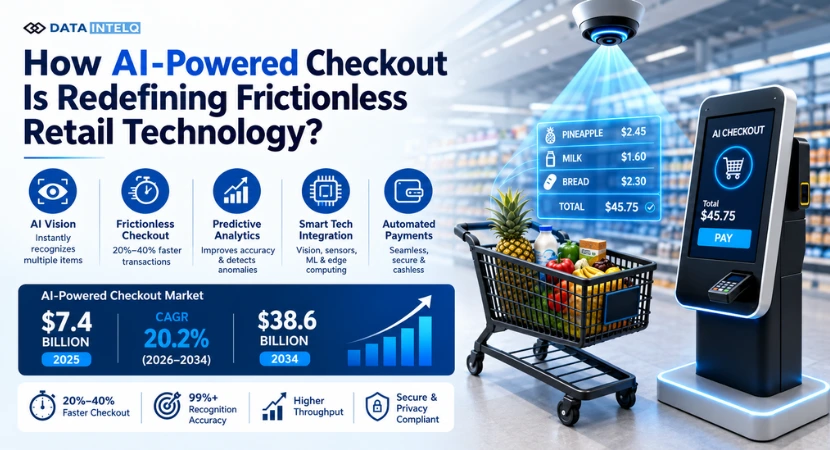
AI-powered checkout uses computer vision, sensors, and machine learning to identify products and process payment without barcode scanning or a cashier.
Cameras and sensors track items as shoppers pick them up, software matches them to a running total, and payment happens automatically when the customer leaves.
This isn’t a minor upgrade to the register. It turns checkout into a live data feed.
Every scan-free transaction updates inventory, feeds loss-prevention models, and sharpens demand forecasting in real time.
This isn’t a minor upgrade to the register. It turns checkout into a live data feed — one more layer of the high-performance digital infrastructure modern retail now runs on.
Why is retail investing so heavily in AI-powered checkout?
Because the math scales brutally.
A traditional checkout, relying on barcodes and a cashier, takes 3 to 5 minutes for a 15 to 20 item basket, longer at peak hours. Shave 30 seconds off one transaction and it means nothing.
Multiply that across thousands of daily transactions and it’s real throughput back on the floor.
The AI-powered checkout market reflects that pressure.
According to Data Intelo, the global market was valued at $7.4 billion in 2025 and is projected to reach $38.6 billion by 2034, a 20.2% CAGR from 2026 to 2034.
Other research firms size the category differently (market.us puts 2025 at $6.67 billion with a steeper 35.4% CAGR to 2035).
It tells you the category is still young enough that analysts don’t agree on its edges. Treat any single market-size figure as directional, not gospel.
How does computer vision recognize products without scanning?
Cameras mounted above shelves, at entrances, and near checkout points track how products move and read their visual features, processing hundreds of frames per second. No barcode pass required.
Accuracy is the real constraint here, not speed.
A system running at 99.5% accuracy across 10,000 daily transactions gets roughly 9,950 right, and around 50 wrong.
That gap closes as models train on larger image datasets covering different packaging, lighting, and shelf layouts, but it doesn’t close to zero.
Retailers evaluating vendors should ask for accuracy numbers under their own store conditions, not a vendor’s lab benchmark.
Does AI-powered checkout actually save time at scale?
Yes, but the size of the win depends on the store’s current baseline, not on which vendor you pick.
Frictionless checkout removes the need to scan each item individually. Cameras and sensors identify everything in the cart, and the customer walks out.
A store running 5,000 transactions daily that cuts average checkout time from 3 minutes to 2 minutes gains meaningful staff-hours back over a full day.
During peak hours, that same improvement lets the same footprint absorb 20 to 40% more transaction volume without adding lanes or cashiers.
The exact hours saved depend heavily on current staffing model and basket size, so treat any specific hour-count as an illustration, not a guarantee for your store.
How does predictive analytics improve transaction accuracy?
Predictive analytics flags transactions that deviate from historical patterns, catching pricing errors, inventory mismatches, and theft attempts before they compound.
A system tracking 50,000 product movements weekly checks each one against expected inventory patterns.
A 1% deviation rate across that volume means about 500 movements worth a closer look.
That’s not a flaw in the system. It’s the system doing its job: surfacing the anomalies a human reviewer would otherwise never catch at that volume.
What technologies power AI-powered checkout systems?
| Technology | What it does |
| Computer vision | Identifies products and tracks customer movement simultaneously |
| Edge computing | Processes data locally, cutting response time from seconds to near-instant |
| Machine learning | Improves recognition and anomaly detection as transaction data accumulates |
| Sensor fusion | Combines cameras, weight sensors, RFID, and shelf sensors for higher accuracy |
| Automated payments | Processes digital payment without manual reconciliation |
No single technology on this list does the job alone. AI-powered checkout works because these layers cross-check each other.
A weight sensor catches what a camera misses, and a camera catches what an RFID tag can’t the same cross-checking logic that’s driving the broader push toward AI-driven workflow automation across retail operations.”
How does AI-powered checkout change day-to-day store operations?
It reshapes staffing, layout, and customer flow, not just the register itself.
| Operational area | Traditional approach | AI-powered checkout impact |
| Checkout time | 3 to 5 minutes per transaction | Reduced by an estimated 20 to 40% |
| Product recognition | Individual barcode scanning | Multiple items recognized at once |
| Inventory updates | Periodic or manual | Near real-time |
| Payment processing | Cashier-assisted | Automated, digital |
| Daily capacity | Limited by counter count | Higher throughput potential |
A bank of ten checkout counters takes up floor space that automated systems don’t need.
A store cutting average transaction time by 25% can absorb more daily volume without adding checkout staff, though actual capacity gains depend on product mix, network reliability, and how quickly customers adapt to the new flow. None of this is automatic.
It requires the store to actually redesign layout and staffing around the new bottleneck, which usually isn’t checkout anymore, it’s restocking and customer support.
What are the accuracy and privacy risks of AI-powered checkout?
Misidentified products, system faults, and payment errors are the operational risks. At 99% system accuracy, expect roughly 100 errors per 10,000 purchases, a number that sounds small until it’s multiplied across a chain.
Privacy is the harder problem. Camera-based systems collect behavioral data on every shopper who walks in, whether or not they’re the one being billed. Retailers deploying this technology need clear data retention policies, opt-out mechanisms where required by law, and cloud-ready access controls that match the sensitivity of what’s being collected. Skipping this step isn’t a hypothetical risk. It’s the fastest way to turn a checkout upgrade into a regulatory problem.
Where is AI-powered checkout headed next?
Toward tighter integration between computer vision, RFID, sensors, cloud platforms, and payment rails, with less human intervention at every step.
At scale, small speed gains compound fast. Cutting checkout time by 10% across 100,000 transactions saves a meaningful chunk of labor time every month. The real shift isn’t eliminating checkout as a concept. It’s folding recognition, payment, inventory, and analytics into one system that runs itself, with humans stepping in only when the system flags something it can’t resolve on its own.
