Four people and 1 Bloomberg seat. That’s the actual problem, not “we want something cheaper.” A single seat of Bloomberg runs $31,980 a year, minimum two-year term. Add three more and a small desk is committing over $250,000 before year two even starts.
Also, a 3-person RIA and a 15-person boutique fund don’t need the same stack. Firm size changes the right answer.
This blog reviews 12 best Bloomberg Terminal alternatives sorted by what a small firm actually needs, data, compliance-ready reporting, private-market research, or team pricing, with real per-seat costs for each.
Quick Comparison of Best Bloomberg Alternatives For Small Firms
| Tool | Best for | Starting price | Team/seat pricing | Bloomberg feature replaced |
|---|---|---|---|---|
| Koyfin | Data + research backbone for a lean team | Free / $39 mo | Advisor plans, 3+ seat quotes | Market data, fundamentals |
| TradingView | Technicals-driven decisions | Free / $15–$60 mo | Per-seat, no firm discount tier | Charting |
| YCharts | Advisor-facing client reporting | Quote-based (~$6,000/seat/yr top tier) | Yes, advisor tiers | Presentation-ready reports |
| Benzinga Pro | A desk that trades on headline speed | $27–$117+ mo | Per-seat, add-ons stack | Real-time newsfeed |
| Seeking Alpha | Outside analyst research | $239/yr | Weak past 2–3 seats | Research/analyst reports |
| AlphaSense | Strategy or IR teams buried in filings | Enterprise quote | Yes, built for teams | Document search & synthesis |
| FactSet Workstation | A firm that’s outgrown “small” in complexity | Enterprise quote (historically $12K+/seat/yr) | Yes | Portfolio & risk analytics |
| S&P Capital IQ Pro | Small PE/credit/corp-dev deal work | Enterprise quote | Yes | Private-company & transaction data |
| PitchBook | Sourcing deals, tracking private markets | Enterprise quote | Seat-tiered | Private-market intelligence |
| Morningstar Direct | A wealth shop built around funds/ETFs | ~$17,500+/seat/yr | Volume discounts | Fund/ETF research & reporting |
| LSEG Workspace | Excel-heavy teams needing a Reuters feed | Enterprise quote | Yes | Cross-asset data + news |
| OpenBB | A technical team wanting zero subscription cost | Free, open-source | N/A | Scriptable research platform |
The 12 Best Bloomberg Terminal Alternatives For Small Firms Reviewed
Ordered from cheapest and most accessible to most institutional, the way a small firm actually narrows a shortlist down: start cheap, add depth only where the job genuinely needs it.
1. Koyfin
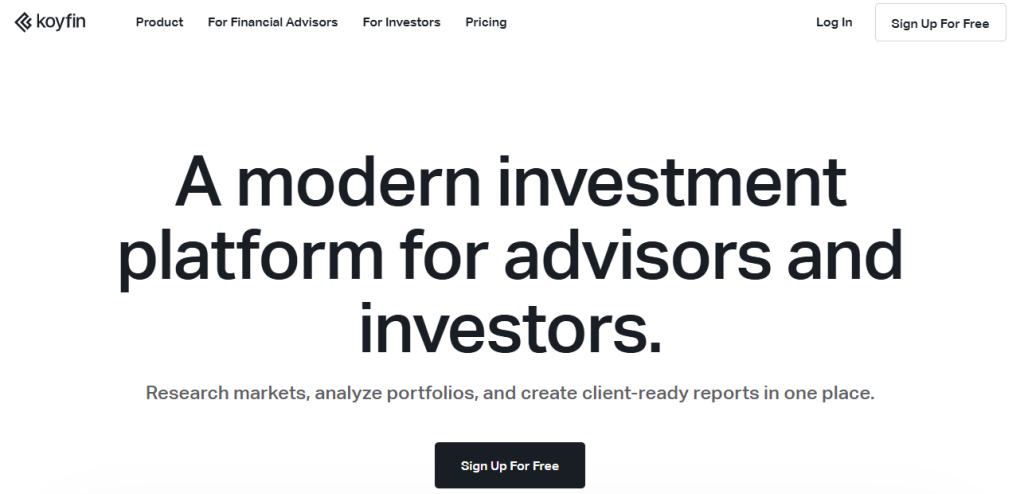
Koyfin sits among the top Bloomberg Terminal alternatives for small firms for Bloomberg’s market data, fundamentals, and charting for a fraction of the cost.
It’s the strongest starting point on this list for a lean team. The free tier alone covers basic dashboards and watchlists, and the paid tiers add ten years of financials, unlimited screening, and custom formulas without asking for a five-figure commitment.
Advisor plans extend that further with custodian integrations and client-proposal tools, built specifically for small RIAs, not bolted on as an afterthought.
The gap: there’s no personal or account-linked portfolio intelligence here. Koyfin shows you everything about a stock; it knows nothing about how that stock sits inside your firm’s actual book. For firms that mainly need stock screening and fundamental filtering, a dedicated screener can be a simpler alternative to a full research platform.
Pricing: Free at entry, $39/month (Plus) at 1 seat, up to $299/seat/month (Advisor Pro); team quotes available at 3+ users.
Best for: the data and research backbone of a lean team building its stack from scratch.
2. TradingView

TradingView is among the best Bloomberg Terminal alternatives for small firms for charting and technical analysis.
For a firm that trades off price action, this is close to unmatched at any price. Pine Script lets you build and backtest custom indicators, multi-chart layouts handle real technical workflows, and the community layer surfaces setups other traders are watching in real time, something no Bloomberg screen offers.
Traders comparing technical-analysis platforms may also consider other software for charting and active market analysis.
The gap: it’s a charting tool, full stop. No fundamentals depth or portfolio tracking. Nothing resembling a compliance or client-reporting layer. Team billing exists, but you’re still buying seats for a single-purpose product, not a firm platform.
Pricing: Free at entry, $15–$60/month per seat on paid tiers; no firm-wide discount structure beyond standard seat counts.
Best for: any small firm whose decisions run through price action and technicals first.
3. YCharts
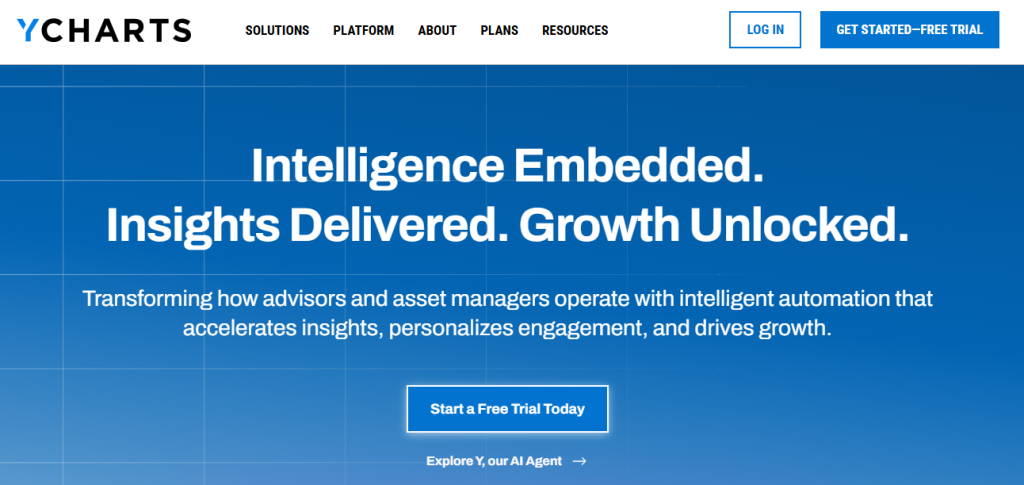
YCharts replaces Bloomberg’s presentation-ready charting and client reporting.
This is the one built explicitly for advisors, not adapted for them. Branded reports, a Proposal Builder, and an Excel add-in on the Professional tier solve the actual problem small advisory firms have: not a data shortage, a communication gap between what the firm knows and what the client sees.
The gap: the interface hasn’t kept pace with newer competitors, there’s no real-time news wire, and there’s no AI-assisted research layer. You’re paying for polish on the client-facing side, not analytical horsepower.
Pricing: $3,600/year per seat (Standard/Analyst tier), $6,000/year per seat (Professional tier); Enterprise is custom-quoted for firm-wide deployments.
Best for: advisory-facing small firms whose business depends on client-ready reporting.
4. Benzinga Pro
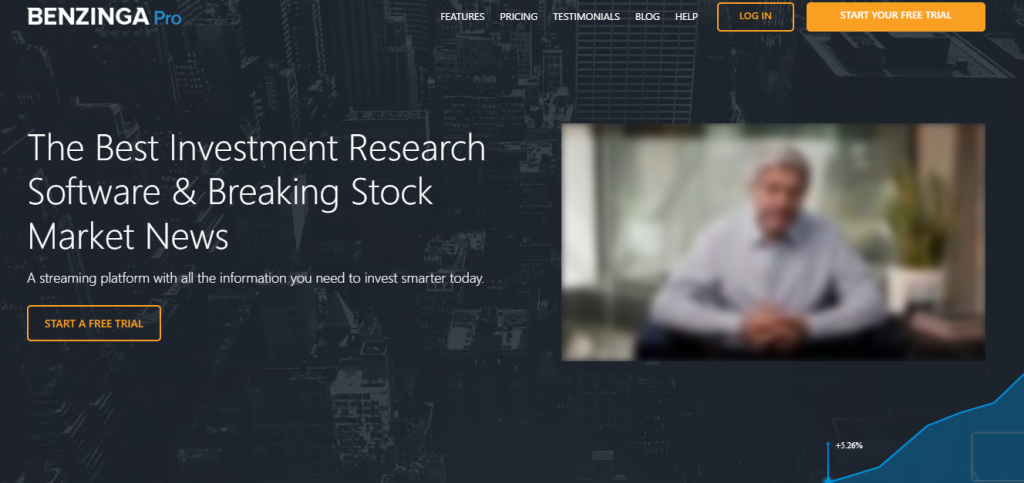
Benzinga Pro replaces Bloomberg’s real-time newsfeed.
Speed is the entire pitch, and it delivers. The audio squawk, “Why Is It Moving?” alerts, and scanner-driven workflow exist for one job: telling a trader what just happened before anyone else does. For a small desk that lives and dies on headline timing, that’s worth paying for on its own.
The gap: this isn’t a research Bloomberg Terminal alternative in any real sense. Some of the more useful tools sit behind add-ons, and costs stack quickly once you’re past the entry tier.
Pricing: $27–$117+/month per seat depending on tier, with several capabilities gated behind additional add-ons.
Best for: a small trading desk whose edge depends on headline speed.
5. Seeking Alpha
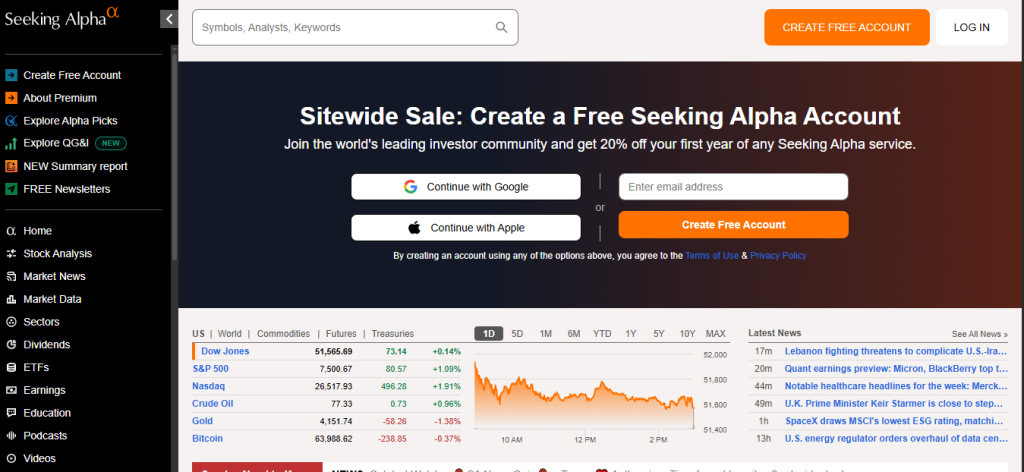
Seeking Alpha is among Bloomberg Terminal alternatives that offers analyst research and third-party investment commentary.
Volume is the value here. Over 7,000 contributors publish more than 10,000 articles a month, meaning almost any stock a small firm is researching already has multiple outside takes, bull and bear, to stress-test in-house thinking against. The Quant Rating system adds a quantitative layer on top of that opinion content.
The gap: contributor quality swings wildly, from genuinely sharp analysts to first-time writers, and there’s no real-time data or portfolio tooling. Pricing also doesn’t scale cleanly past 2 or 3 seats; this is built for individual subscriptions, not firm licensing.
Pricing: $239/year per seat; no dedicated team-pricing tier.
Best for: supplementing in-house research with a wide spread of outside analyst views.
6. AlphaSense
AlphaSense is among those Bloomberg Terminal alternatives that document search across filings, transcripts, and broker research.
For a small strategy or IR function, the value is speed of synthesis. Instead of manually hunting through filings and call transcripts for one sentence, semantic search surfaces it directly, and that time savings compounds across a team fast enough to justify the sales conversation once you’re past a couple of seats.
The gap: this replaces zero percent of Bloomberg’s market-data function. No pricing, no charting, nothing resembling a terminal. It’s an acceleration layer on top of other tools, not a standalone replacement.
Pricing: Enterprise, quote-based only; genuinely built for team deployments rather than solo users, worth requesting a quote at 5+ seats.
Best for: a small strategy or investor-relations team buried in filings and transcripts.
7. FactSet Workstation
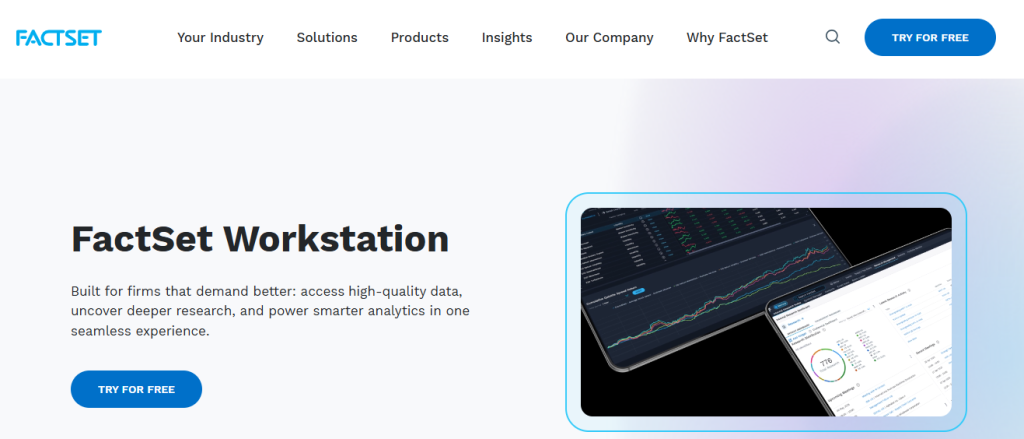
FactSet Workstation replaces Bloomberg’s portfolio analytics, risk tools, and fixed-income research.
This is the first tool on this list actually built for compliance-grade deployment, desktop and virtual-machine rollout options included. If a small firm has grown past informal research into something IT and legal need to sign off on, FactSet’s enterprise deployment discipline is the reason it shows up on shortlists here.
The gap: reported per-seat pricing varies enormously across sources, from roughly $333/seat on entry tiers to $12,000+/seat on fuller configurations, with buyer-reported median contracts closer to $25,000/year. If your team only needs screening and charting, that range is real overkill.
Pricing: No public list price; entry configurations reportedly start near $333/seat/year, full workstation access historically runs $12,000+/seat/year, enterprise quote required.
Best for: a small firm that’s outgrown “small” in workflow complexity, even if headcount hasn’t caught up.
8. S&P Capital IQ Pro
S&P Capital IQ Pro is among the top Bloomberg Terminal alternatives for private-company data, transaction history, and estimates coverage.
For a small PE, credit, or corp-dev shop, this is the strongest private-company and transaction dataset on this list. Office plug-ins pull data straight into models, cutting the copy-paste friction that eats analyst time on comp sets and diligence work.
The gap: this isn’t built for live trading or public-market monitoring. It’s a research and diligence platform, not a terminal, and pricing sits firmly in enterprise territory.
Pricing: Enterprise, quote-based; historically reported around $30,000/organization/year, though current per-seat figures aren’t publicly listed.
Best for: a small PE, credit, or corporate-development shop doing deal and comp work.
9. PitchBook
PitchBook replaces Bloomberg’s private-market coverage entirely, a job Bloomberg was never really built for.
This is the category leader for a reason. Deal sourcing, investor tracking, and sector mapping across private markets are the actual daily job for a small firm doing business development or M&A sourcing, and PitchBook’s tools are tuned specifically for that workflow, not adapted from a public-markets product.
The gap: it’s the wrong Bloomberg Terminal alternative entirely if the job is public-market pricing, trading, or real-time terminal-style monitoring. Pricing is enterprise and seat-tiered, sold through a sales process rather than self-serve signup.
Pricing: Enterprise, quote-based, seat-tiered; no public per-seat figure.
Best for: a small firm sourcing deals or tracking private-market activity as its core job.
10. Morningstar Direct
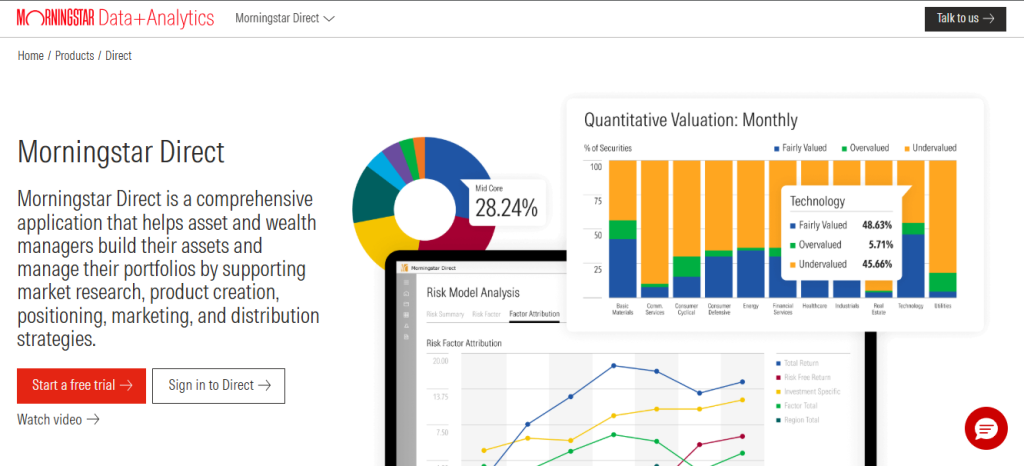
Morningstar Direct replaces Bloomberg’s fund and ETF research and advisor-facing reporting.
Narrow by design, strong within that lane. Presentation Studio and its reporting workflows solve a real problem for wealth and advisory shops: most don’t need more market noise, they need advisor-ready output a client or committee can actually use.
The gap: it doesn’t behave like Bloomberg for intraday monitoring or cross-asset trading, and shouldn’t be judged as if it does. Pricing sits well above entry-tier alternatives on this list.
Pricing: Historically around $17,500+/seat/year for a single license, with volume discounts available for additional seats.
Best for: a small wealth or advisory shop built around fund and ETF selection.
11. LSEG Workspace (formerly Refinitiv Eikon)
LSEG Workspace replaces Bloomberg’s cross-asset data feed and news wire most directly of anything on this list.
It’s the closest like-for-like Bloomberg Terminal alternative in scope: Reuters news, cross-asset pricing, and deep Excel and Office integration for firms whose analysts already live in spreadsheets all day. That familiarity matters more than vendors usually admit, since tool changes fail when they force senior staff to relearn muscle memory mid-workflow.
The gap: this is still enterprise pricing and enterprise complexity. Despite the “alternative” framing, it rarely functions as a genuinely small-firm-friendly option in practice.
Pricing: Enterprise, quote-based; no public small-firm pricing tier exists.
Best for: a small firm already living in Excel and Office that specifically needs a Reuters news feed.
12. OpenBB
OpenBB replaces Bloomberg’s fundamentals, screening, and economic-data access, at zero subscription cost.
This is the most interesting option on the list for a technical small team. It’s open-source, scriptable in Python, and extensible, meaning a quant-leaning shop or fintech-adjacent fund can wire it directly into an existing research pipeline instead of working around a closed platform.
The gap: there’s a real learning curve, you’re often wiring up your own data keys, and the polish is uneven next to any commercial product here. This is not a plug-and-play Bloomberg Terminal alternative for a non-technical team.
Pricing: Free, open-source.
Best for: a technical small team, a quant shop or fintech-adjacent fund, that wants zero subscription cost and full control over its research stack.
How Can You Choose The Right Bloomberg Alternative For Small Firms?
Answer four questions honestly, and the shortlist picks itself.
What’s the core job?
Live trading, fundamental research, private-market sourcing, or client reporting. Pick one primary job, not all four. Most small firms buy too broad a tool because they’re solving for every use case at once instead of the one that actually drives revenue.
How many seats in 12 months, realistically?
Not today’s headcount, next year’s. Per-seat pricing tiers shift the math, and buying for today’s team means renegotiating everything in month 13.
Does anyone need audit-trail or compliance-grade entitlements?
An RIA with client assets under management has a different bar than two people running a personal fund. If compliance sign-off is real, that rules out anything without entitlement controls, straightaway.
Does Firm Size Change Which Bloomberg Alternative Is Best?
Yes. Three things shift the moment you’re buying for a team instead of one desk.
Seat pricing matters now. Per-seat cost drops with volume on almost every platform, Bloomberg included. The best tool for one person isn’t automatically the best tool for five. Run the math at your actual seat count before picking anything.
Someone has to sign off. A solo investor answers to no one. A firm has compliance, an ops lead, or a managing partner who needs audit trails, entitlements, and reporting output, not just raw data access.
Data has to change hands. An analyst pulls a number. A partner builds a model with it. A client sees a report built from it. Tools built for solo research often break down right at that handoff, because nobody designed them to pass work between people.
The question this article answers isn’t which tool is best. It’s which category your firm actually needs, and what that costs at your seat count.
That same distinction matters when evaluating financial market platforms, since the right choice depends on whether you need research, trading, analytics, or reporting.
What’s the One Bloomberg Feature You Would Genuinely Miss?
For a bond desk, that’s Instant Bloomberg (IB) chat, still where a meaningful share of OTC trades get negotiated, and no alternative on this list replicates that network.
For an equity-only shop, it’s usually just data breadth and news speed, both replaceable. Firms with a more specialized derivatives workflow may need a platform designed specifically around options trading and strategy execution. So, match your answers to a starting point.
- Deal sourcing → start at PitchBook, stop reading the rest of the list.
- Client-facing advisory work → start at YCharts or Koyfin’s advisor tier.
- Filings and transcript-heavy research → AlphaSense.
- Everything else → Koyfin as it covers the most ground for the least cost.
Last Word on Best Bloomberg Terminal Alternatives for Small Firms
There’s no single winner here. The right Bloomberg Terminal alternative for a small firm depends entirely on the job. What ties all 12 together is the math. A single Bloomberg seat runs $31,980 a year, minimum two-year commitment. Most small firms don’t need to replace that number with one tool. They need two or three, chosen against the actual job, at a fraction of the cost.
Start with the four questions from the decision framework above. Match the answer to the tool built for that specific job, not the tool with the longest feature list.
FAQs About Best Bloomberg Alternatives for Small Firms?
Q#1. What is the cheapest real Bloomberg Terminal alternative for a small firm?
Koyfin and TradingView both offer usable free tiers, with paid plans starting at $39/month and roughly $15/month respectively. Neither replicates Bloomberg’s full breadth, but together they cover fundamentals, charting, and screening at under $50/month per seat, versus $2,665/month for a single Bloomberg seat.
Q#2. How much does Bloomberg Terminal cost per seat in 2026?
A single-terminal subscription costs $31,980 per year ($2,665/month) as of 2026, on a standard two-year minimum contract. Firms running multiple terminals pay a reduced multi-seat rate of $28,320 per seat per year ($2,360/month). Bloomberg doesn’t publish these prices directly; they come from client-reported contract data and industry pricing trackers.
Q#3. Can a small firm realistically replace Bloomberg with more than one tool?
Yes, and most small firms end up doing exactly this. Bloomberg bundles market data, news, analytics, and messaging into one product; smaller firms typically replace it with two or three specialized tools instead, each covering the piece Bloomberg does well for that specific job.
Q#4. there a Bloomberg alternative built specifically for small RIAs or advisory firms?
YCharts is built explicitly for advisors and wealth teams, with branded client reports and portfolio-facing analytics as its core focus. Koyfin’s Advisor plans serve the same market with custodian integrations and proposal-ready output, generally at a lower per-seat cost than YCharts’ top tier.
Q#5.What’s the best Bloomberg alternative for a small firm doing private-market or deal work?
PitchBook is the strongest option for deal sourcing, investor tracking, and private-company data. For firms that also need fundamentals and transaction comps alongside private-market data. S&P Capital IQ Pro covers a wider research base, though both are enterprise, quote-based products without public small-firm pricing.
Q#6. Do any of these alternatives offer real-time data at small-firm pricing?
TradingView offers real-time data for stocks, crypto, and forex starting around $15–$60/month, though some exchange-specific feeds require paid add-ons. Koyfin offers real-time equity data on its paid tiers starting at $39/month. Neither matches Bloomberg’s real-time coverage across bonds, derivatives, and commodities, which remains one of the harder gaps to close outside enterprise-tier tools.
