Claude Fable 5.1 and Mythos 5.1 dropped on September 1, 2026, and the benchmarks Anthropic published are hard to ignore.
Claude Fable 5.1 more than doubled its predecessor on Terminal-Bench-Science 0.1—52.6% against Fable 5’s 24.7%.
Cache reads now cost 75% less, which in practice drops the bill by roughly 25% for typical work and up to 45% for highly agentic tasks. Claude Fable 5.1 and Mythos 5.1 are faster in several benchmarks, the gap between it and everything else is widening.

But benchmarks are not the story here. Within hours of the announcement, developers, researchers, and founders were already stress-testing these models on real jobs. The early output matters because it shows what the model actually does when you hand it a problem.
This blog is not a Claude new model spec sheet. It is a collection of the most interesting real-world Claude use cases people shared publicly after launch.
Here are the most exciting real-world use cases users shared within hours of Fable 5.1 and Mythos 5.1 launch.
Generating Motion Videos with Minimal Iteration
Claude Fable 5.1 demonstrates strong performance in producing motion videos through iterative but highly efficient generation processes.
In one documented case, the model generated a complete motion video in approximately 19 minutes, requiring only two subsequent adjustments to reach a satisfactory result. This capability highlights its utility for rapid prototyping of visual content, where users provide high-level directives and receive polished outputs with limited manual refinement.
The efficiency reduces the typical cycle of multiple revisions common in traditional video production workflows, making it suitable for content development cycles acceleration.
One-Prompt Brand Identity Creation
Claude Fable 5.1 and Mythos 5.1 enable the generation of complete brand identities from a single prompt.
Users have successfully produced cohesive visual branding elements, including logos and associated design systems, by issuing concise instructions that incorporate stylistic preferences and conceptual themes.
The resulting assets exhibit thoughtful combinations of color palettes, typography, and illustrative motifs, such as unexpected pairings of modern elements with classical artistic references.
This use case of new Claude fable and Mythos models underscores the capacity for creative synthesis in design tasks, allowing brand designers and startups to explore multiple identity directions rapidly.
Scientific Research Re-implementation and Computational Optimization
Claude Fable 5.1 has proven effective in advanced knowledge work, particularly the re-implementation and extension of scientific research.
When provided with an existing graduate-level paper, the model reproduced the full set of calculations, identified and corrected errors by relaxing prior approximations, derived an analytically solvable model not previously considered, and extended the original work by addressing a more complex problem identified as future research.
The process required approximately seven hours of model operation.
Separately, Claude Mythos 5.1 generated custom GPU kernels that accelerated open-source computational biology models by a factor of 2.5 while reducing associated GPU costs by 30 to 60 percent, with plans to release the optimizations as open-source contributions.
These applications illustrate the models’ value for researchers seeking to validate, refine, and scale computational aspects of scientific inquiry.
Frontend Game Development and Comparative Evaluation
Claude Fable 5.1 exhibits competitive performance in frontend game development, particularly in recreating interactive experiences with polished user interfaces and mechanics.
Side-by-side evaluations against alternative models, such as Kimi K3, show Fable 5.1 producing smoother gameplay interactions and higher overall visual and functional quality, albeit at a higher token cost (approximately 60 percent greater in one comparison).
These results position the new Claude model as a strong candidate for developers prioritizing refined frontend experiences in game prototypes.
One-Shot Interactive Game Prototyping
Claude Fable 5.1 supports rapid creation of playable interactive experiences from minimal input.
In one Fable and Mythos Claude use case, the model generated a complete yacht-based game in a single generation pass, producing functional mechanics, visual assets, and an accessible playable version.
The resulting prototype demonstrates the model’s ability to translate high-level concepts into coherent, immediately testable applications, significantly shortening the path from idea to interactive demonstration.
This capability benefits independent developers and educators who require quick validation of game concepts without extensive coding overhead.
Complex Open-World Game Construction from a Single Prompt
Claude Fable 5.1 has been applied to the generation of substantial open-world environments in a single pass.
One documented example involved the creation of a complete Minecraft-style clone set within a Red Dead Redemption-inspired town, incorporating functional elements such as bars, a train station, non-player characters, buildings, and a navigable open world.
Observers noted measurable improvements in game-development performance relative to prior models, estimated in the range of 10 to 20 percent for certain tasks.
This new Claude use case of Fable 5.1 and Mythos 5.1 highlights the potential of enabling “vibe coding” approaches in which detailed environments emerge from concise descriptive prompts.
Code-Driven Architectural Visualization and Cinematic Walkthroughs
Claude Fable 5.1 excels at generating videos through programmatic means, particularly when combined with tools such as headless Blender. When supplied with an image of a property lot, the model designed a suitable residential structure, rendered the architecture, and produced a cinematic walkthrough sequence.
The process integrates spatial reasoning, design generation, and automated rendering pipelines, resulting in polished visual outputs suitable for real-estate visualization, architectural presentation, or conceptual exploration.
This application demonstrates the model’s strength in bridging high-level design intent with executable code that drives professional-grade visual production.
Generating Detailed 3D Aircraft Models Entirely in Code
Claude Fable 5.1 supports the creation of highly detailed three-dimensional models through pure code generation.
In an initial evaluation, the model produced a complete representation of an F-35A Lightning II fighter aircraft, with every visible component.
The resulting visualization demonstrates precise adherence to the aircraft’s distinctive form, including aerodynamic surfaces and intricate design features, achieved from a straightforward descriptive request.
This capability positions the model as a practical tool for engineers, educators, and visualization specialists who require rapid, code-based production of complex technical assets without reliance on specialized 3D design environments.
Patterns Across These Fable 5.1 and Mythos 5.1 Use Cases
After watching a dozen early demos, a few patterns stand out that are worth naming before you pick one to try yourself.
Fable 5.1 excels at long-running, agentic tasks where context has to stick around
The model does not lose the thread after twenty steps. Users are running it for full customer calls, multi-section research papers, and codebase audits that span thousands of lines.
The CursorBench 3.2.0 chart Anthropic published shows this clearly:
- At low effort, Fable 5.1 already scores around 66%, while Fable 5 at low effort sits at roughly 62%.
- At max effort, Fable 5.1 hits about 74% against Fable 5’s 70.5%. The gap is consistent across effort levels.
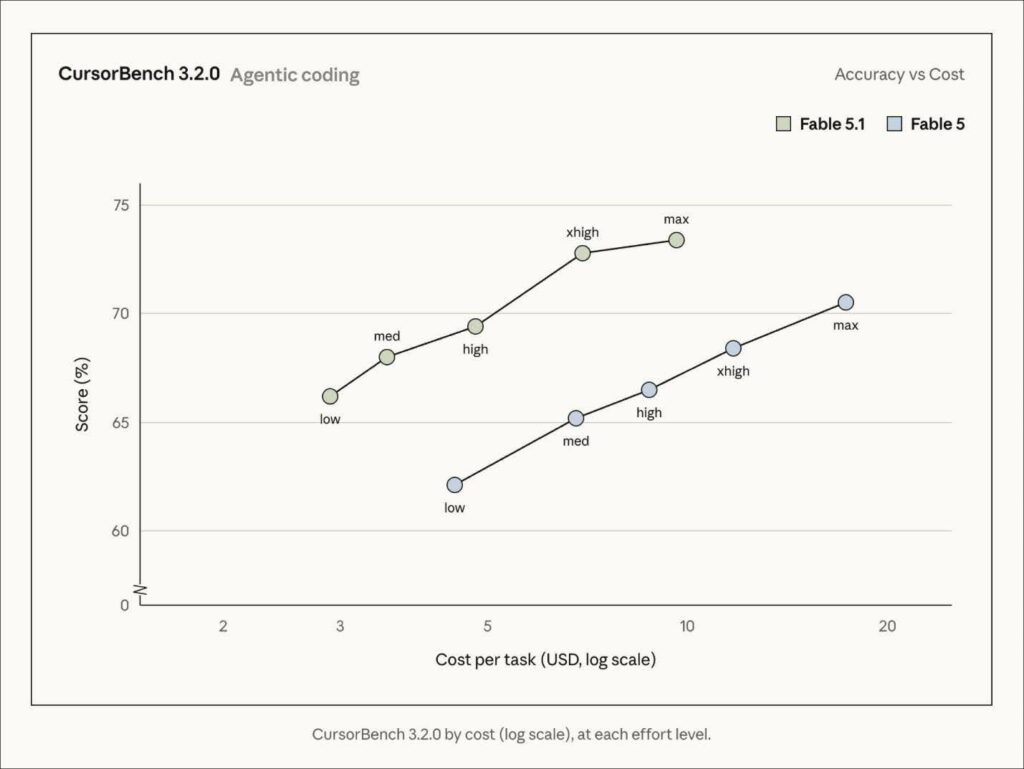
However, the real win is that you can run the model cheaper and still beat the old version’s best output.
Mythos 5.1 is the same model with the handcuffs loosened for specific fields
Anthropic confirmed this directly: “Claude Fable 5.1 and Claude Mythos 5.1 are the same underlying model.”
The gap between them, 60.9% vs 55.8% on Terminal-Bench 4.0, for example, reflects tasks where older, less precise cyber safeguards used to intervene and shut down benign requests.
The Terminal-Bench 4.0 chart shows Mythos 5.1 pulling ahead of Fable 5.1 at every effort level, sometimes by five to ten points.
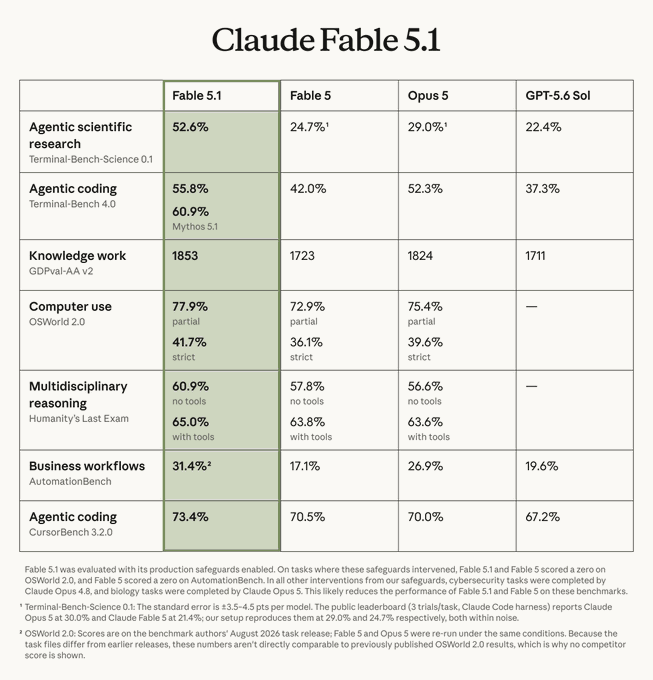
Anthropic says they are improving these safeguards and expect the gap to shrink. But for now, if your work touches cybersecurity or the life sciences, Mythos 5.1 Claude’s new version will actually finish the job.
Both Claude Fable 5.1 and Mythos 5.1 reward specificity
The demos that produced the cleanest output had prompts that defined the goal, the constraints, and the output format upfront.
The new Claude models can handle ambiguity, but they handle clarity better. You can run the code, check the protein designs, or read the research draft and know quickly whether it worked. That does not mean it is production-ready out of the box.
Every demo of Claude’s new models that looked polished on X had a follow-up thread where the author fixed a bug, tightened a layout, or verified a citation.
You get the working draft fast. The last ten percent is still human work.
How to Access and Replicate Fable 5.1 & Mythos 5.1 Use Cases
Fable 5.1 is available everywhere today
You can reach it through Claude.ai, the API, and Claude Code. There is no waitlist or special program.
If you already use Claude for work, the model is in the selector now.

Mythos 5.1 requires going through a trusted access program
Anthropic is offering two verification tracks: the Cybersecurity Verification Program for security researchers and red teams, and the Life Sciences Verification Program for biologists and medical researchers.
You apply, get vetted, and if approved, you get access to a model whose safeguards are tuned for your field.
Anthropic also mentions a broader “Claude Team plan for scientists” with discounted usage, though details on that are still thin.
A practical tip for these new Claude models
Start at low effort.
The accuracy-versus-cost charts for CursorBench, Humanity’s Last Exam, and Terminal-Bench all show Fable 5.1 outperforming Fable 5 at every effort tier.
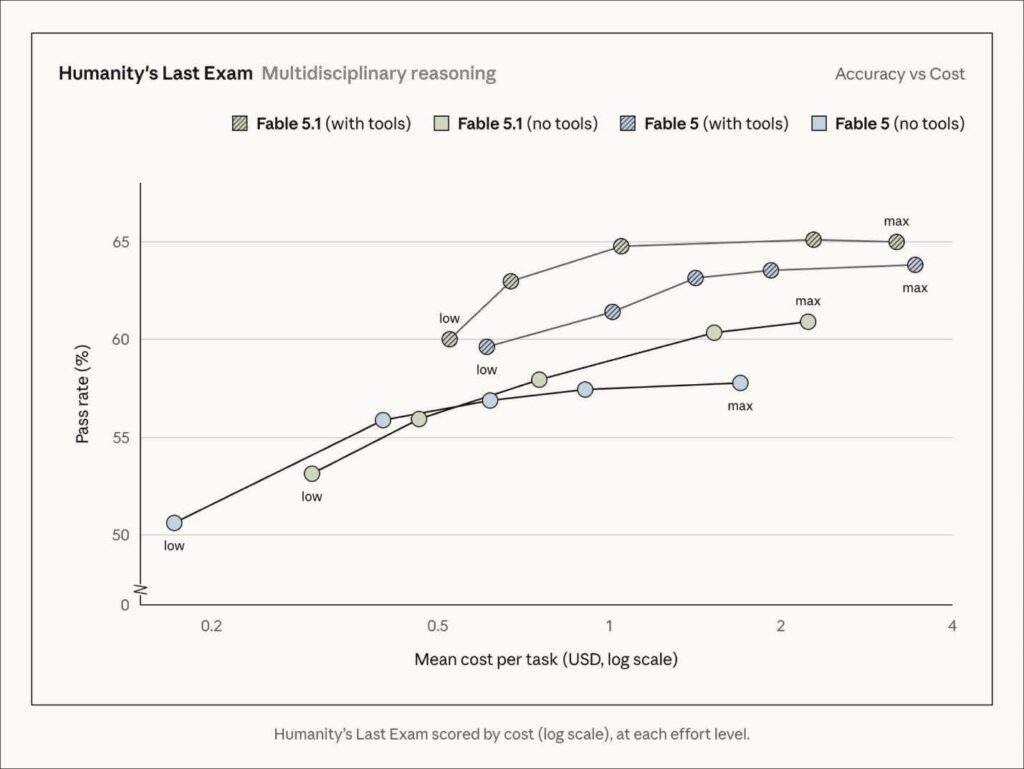
That means you can prototype at low or medium effort, get output that would have required max effort from the previous model, and only burn tokens on high or max effort when you are polishing for production.
The model is cheap enough to iterate on, which is the point.
Last Word on Claude Fable 5.1 and Mythos 5.1 Use Cases
The demos people shared within hours of launch were not stunts. A developer built a working Minecraft clone. A biologist generated protein binder designs with hit rates ten times higher than standard methods. These are not theoretical applications. They are real tasks, done by real people, with output they could test immediately.
The pattern across every successful demo was the same: the user picked a task that matched their actual work, gave the model a clear prompt with real constraints, and then reviewed the output before shipping it. No one treated the result as final. Everyone treated it as a fast first draft.
So, pick one use case from this list that overlaps with what you already do. Fix what is broken. Scale to max effort when you need polish.
