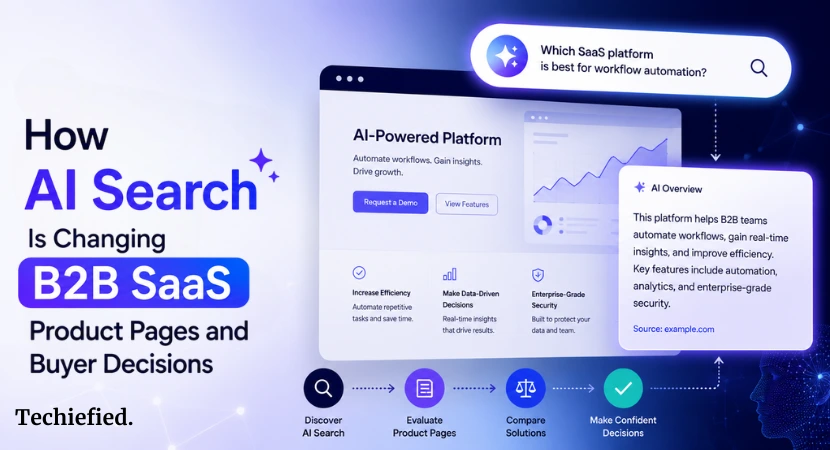
A buyer finds your company on Google. Then they open Reddit, ask ChatGPT, compare alternatives on G2, watch a product walkthrough on YouTube, and skim LinkedIn for customer opinions. By the time they reach your website, they’ve already built an opinion.
That changes the job of B2B SaaS product pages.
The product page no longer introduces your software. It confirms what buyers already believe. If every touchpoint before your website creates confidence, your product page moves the deal forward. If those touchpoints create doubt, the best-designed page won’t fix it.
The numbers point in the same direction.
Research from Taboola found that B2B buyers consume multiple pieces of content before speaking with a sales team. Gartner has also reported that buyers spend only a small portion of their buying journey meeting suppliers. Most of their time goes into independent research.
That’s why companies that publish comparison pages, customer stories, documentation, benchmark reports, and educational content often earn more qualified pipeline than companies that keep polishing product pages.
The question now is whether you’re investing enough in everything buyers read before they reach one?
Research on SaaS Product Pages Happens Before The Sales Call
The buying process starts long before someone books a demo. Your prospects are already comparing products, reading reviews, asking AI assistants for recommendations, and checking whether other companies trust your software.
For enterprise purchases, that research phase can last weeks or months. During that time, buyers collect evidence from dozens of sources without talking to your sales team.
- Taboola’s research found that B2B buyers consume multiple pieces of content before contacting a vendor.
- Gartner has also reported that buyers spend only a fraction of their buying journey meeting suppliers.
If your website only has a homepage, a pricing page, and a product page, buyers leave your site to find the answers elsewhere.
They search Google, ask ChatGPT, browse Reddit, compare G2 reviews, watch YouTube demos, and read independent blogs.
Here’s what a typical buyer wants to know before requesting a demo:
- How does this compare to Competitor X?
- Does it integrate with my existing stack?
- Are customers happy after 12 months?
- What’s the implementation process?
- What happens if I outgrow the product?
- Is the vendor financially stable?
- What do independent reviewers say?
Very few of those answers belong on a traditional B2B SaaS product page. They belong in comparison pages, customer stories, documentation, benchmark reports, pricing explainers, helpful articles, and educational content.
Companies that publish this content remove uncertainty before sales ever joins the conversation. Sales calls become shorter because buyers already understand the product, the pricing, and where it fits.
That’s one reason many SaaS companies now measure assisted conversions across their entire content library instead of judging success by product page conversions alone.
Hidden Decision Makers No One Is Writing For
Most B2B purchases involve more than one person. A marketing manager might find your software, but they rarely approve the purchase alone. Finance checks the cost. IT reviews security.
Operations looks at implementation. Legal scans contracts. Procurement negotiates terms. Each person asks different questions.
The problem is that many B2B SaaS product pages speak to only one audience. They focus on features, screenshots, and benefits for the primary user. The rest of the buying committee has to search elsewhere for the information they need.
Here’s what different stakeholders care about:
| Stakeholder | Questions they need answered |
|---|---|
| Finance | What’s the ROI? Are there hidden costs? Can pricing scale with our team? |
| IT | Does it support SSO? Which APIs are available? Is the infrastructure secure? |
| Security | SOC 2? ISO 27001? GDPR? Data residency? |
| Legal | Data Processing Agreement? SLA? Contract terms? |
| Operations | How long will implementation take? What resources are required? |
| End Users | Will this save time? Is it easy to learn? |
If those answers aren’t available, buyers start searching Google, asking AI assistants, or emailing your sales team. The companies that shorten sales cycles make these answers easy to find.
They publish security documentation, compliance pages, ROI calculators, migration guides, API documentation, implementation checklists, customer case studies, and pricing explainers.
That content rarely ranks among the highest-traffic pages on a website.
When someone from finance, legal, or IT lands on one of those pages, they’re already close to making a decision. Helping them answer one important question can move the entire deal forward.
Your Real Product Page Lives Outside Your Website
Open ChatGPT and ask for the best CRM for startups. Search Reddit for payroll software. Read G2 reviews before buying a project management tool.
That’s how people buy software today.
Your B2B SaaS product page is only one stop in a much larger research journey. Buyers build confidence through dozens of sources before they reach your website.
A typical journey looks like this:
- Google search results
- AI answers from ChatGPT, Gemini, or Perplexity
- Reddit discussions
- G2 and Capterra reviews
- LinkedIn posts from customers and industry experts
- YouTube product reviews and walkthroughs
- Documentation and API references
- Competitor comparison articles
- Customer case studies
Every one of those touchpoints shapes the buying decision.
This also changes how search works.
Large language models don’t read only your homepage. If independent sources explain your product better than your own website does, those sources often become the reference buyers see first.
That’s why many SaaS companies invest in content that answers buying questions long before someone clicks Book a Demo.
- Comparison pages answer “Why should I choose you?”
- Documentation answers “Can this work with our stack?”
- Case studies answer “Has this worked for companies like ours?”
- Customer reviews answer “Can I trust this vendor?”
Each piece removes uncertainty.
A modern content strategy for AI search visibility treats every indexed page as part of the sales process. The goal is to give buyers the answers they need wherever they choose to research.
Trust is The New Conversion Strategy
Every buyer asks the same question before they buy.
Can I trust this company?
Your B2B SaaS product pages answer part of that question. A feature list is easy to write.
- A customer case study with measurable results carries more weight.
- A pricing page tells buyers what they’ll pay.
- A transparent implementation guide tells them what they’ll experience after signing the contract.
Here are the signals that influence buying decisions the most:
- Customer reviews on G2, Capterra, and Trustpilot
- Detailed case studies with measurable business outcomes
- Public documentation and API references
- Security and compliance certifications
- Product changelogs that show active development
- Transparent pricing and implementation details
- Expert mentions, media coverage, and industry awards
- Customer testimonials from recognizable brands
These trust signals also support search visibility.
Google rewards websites with strong Experience, Expertise, Authoritativeness, and Trust (E-E-A-T). AI search engines look for many of the same signals when generating answers. Trust doesn’t come from one page. Buyers build it over dozens of interactions.
Every comparison article, help document, customer story, webinar, benchmark report, and review adds another piece of evidence. When prospects finally reach your B2B SaaS product page, they already understand what your software does and why other businesses trust it.
That confidence often determines whether they book a demo or continue evaluating another vendor.
An actionable framework for B2B SaaS content that drives pipeline
You need content that answers the questions buyers ask at each stage of the purchase journey. A simple framework looks like this.
1. Cover every high-intent search
Create content around keyphrases that signal buying intent, such as:
- Competitor comparison pages
- Alternatives pages
- Pricing guides
- Product integrations
- Industry-specific use cases
- Best software lists
- Migration guides
2. Build trust with proof
Every major claim should have evidence behind it.
Publish:
- Customer case studies with measurable results
- Customer testimonials
- Independent reviews
- Security and compliance documentation
- Product changelogs
- Research reports and original data
3. Create content for every stakeholder
Your content shouldn’t speak only to end users.
Develop dedicated resources for:
- Finance teams evaluating ROI
- IT teams reviewing integrations
- Security teams checking compliance
- Procurement teams comparing pricing
- Executives measuring business impact
4. Keep every page current
Old screenshots, outdated pricing, broken integrations, and obsolete statistics reduce credibility.
Review your highest-performing pages every quarter. Update screenshots, product features, competitor comparisons, and customer examples whenever something changes.
5. Measure revenue, not just traffic
Traffic is useful, but pipeline tells you whether your content influences buying decisions.
Track metrics such as:
- Demo requests
- Free trial signups
- Assisted conversions
- Product page visits from blog readers
- Branded search growth
- Organic conversions from comparison pages
The strongest B2B SaaS product pages are supported by dozens of pages that answer buyer questions before sales gets involved. When every piece of content removes one objection, your website becomes part of the sales process instead of a place buyers visit after they’ve already made up their minds.
Ending Note
B2B SaaS product pages still matter because every buyer expects a clear explanation of what your software does, who it’s for, and why it’s worth paying for. Today’s buyers collect information from AI search, Google, review platforms, comparison articles, documentation, social media, and customer stories before they ever request a demo. Every one of those touchpoints influences whether they trust your company.
Treat your website as a collection of buying resources, not a collection of landing pages. When your content supports buyers throughout their research process, your B2B SaaS product pages become the final confirmation instead of the first introduction.
