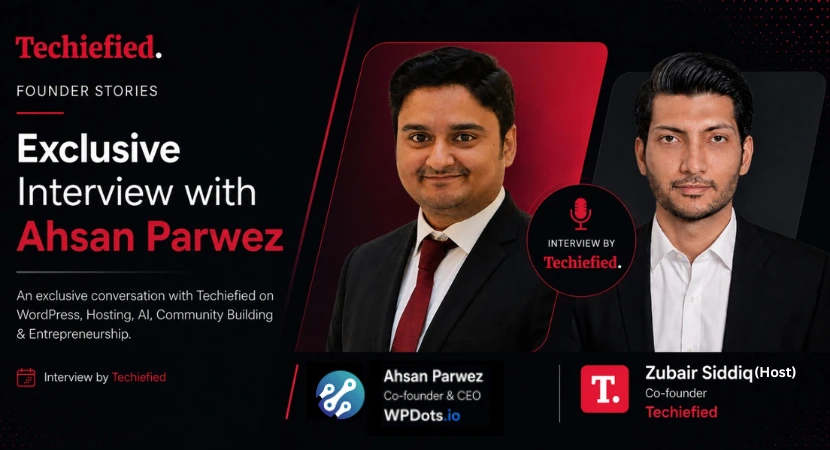
Every industry has its share of “accidental” success stories, but few are as fitting as Ahsan Parwez’s. Trained as an Electronics Engineer, he was supposed to be soldering circuits, not scaling communities. Instead, a tough job market and a self-taught obsession with HTML, CSS, and PHP pushed him toward a career nobody in his family had planned for him and it turned out to be exactly where he belonged.
Ahsan spent over seven years at Cloudways, joining when the company had virtually no customers and helping build the community engine that took it to more than 70,000. Along the way, he picked up stints at Brainstorm Force, Convesio, Patchstack, and InstaWP, a resume that reads like a tour of the modern WordPress hosting and security landscape.
Today, he’s building his own corner of that ecosystem: HostWP.io for managed LiteSpeed hosting, WPfounders for founder stories, CheckWP.io for agency services, and WPapac to give APAC voices a bigger seat at the WordPress table.
In this conversation, Ahsan talks candidly about why community-led growth still beats paid acquisition, why he trusts server architecture over CDN convenience, where AI is genuinely changing WordPress businesses (and where the hype outpaces reality), and the mistakes he sees new founders making in a post-ChatGPT world. He also opens up about why he walked away from the comfort of full-time roles to build something of his own and what he does when he’s not thinking about hosting stacks at all.
Techiefied’s Zubair Siddiq caught up with Ahsan to unpack all of this and more.
Q&A Session with Ahsan Parwez
Q1. You graduated as an Electronics Engineer but built your career in WordPress and digital marketing. What was the turning point that convinced you to pursue WordPress instead of engineering?
I come from a family where becoming an Engineer or Doctor was considered the definition of success. I ended up graduating as an Electronics Engineer largely because of family expectations. That doesn’t mean I didn’t enjoy studying Electronics, but my interests were always more aligned with software and computer engineering.
During my university years, I taught myself how to build simple websites using HTML and CSS through books and, later, online forums. Eventually, I became interested in learning PHP. I kept myself busy learning about IT, and I’ve always enjoyed building computers and restoring older hardware to put it back into use.
When I graduated, the job market in Pakistan had changed significantly. There was very little demand for Electronics and Telecommunications engineers, and even after seven months of searching, I couldn’t find a job.
Since I had already taught myself web development, I started applying to IT companies. Out of desperation, I even applied for SEO, content writing, and digital marketing positions. The first job I landed was as an SEO at an ecommerce startup that worked extensively with large US apparel brands and sold products through Amazon, eBay, and their own ecommerce websites.
Once I got into SEO, I realized the potential of the field. Coming from a technical background, I was able to identify and fix issues that affected a website’s discoverability in search engines. Eventually, I started exploring PPC, open-source software, and content management systems like Joomla, Drupal, and WordPress.
As the IT industry continued to grow and I found work that genuinely interested me, I never looked back at applying for engineering jobs.
Q2. You spent over seven years at Cloudways and were among the first people responsible for building its WordPress community presence. Looking back, what were the biggest lessons you learned about community-led growth?
I joined Cloudways in 2014 and became part of the team when their managed cloud hosting platform had virtually no customers. I saw the company grow from zero to more than 70,000 customers between 2014 and 2021.
My experience there, and everything I had the opportunity to work on, taught me many of the things I know today. I grew from working independently as a Community Manager to eventually leading a team of nearly 25 people dedicated to growing Cloudways within the WordPress ecosystem.
The community strategy had already been established by Saad Khan before I joined, and I was fortunate to be one of the first hires focused on community marketing. Looking back, I can confidently say that community-led growth became one of the strongest foundations behind Cloudways’ success.
Our strategy was actually very simple, but it required consistency and quick execution. We became active members of online forums, Facebook groups, Reddit communities, and anywhere people were discussing WordPress. Instead of promoting Cloudways, we naturally participated in conversations and helped people solve their problems.
The questions people asked in those communities became our content roadmap. We turned those discussions into detailed blog posts and tutorials covering WordPress, PHP, Magento, Laravel, Drupal, and many other topics.
Because we invested heavily in SEO and educational content, our traffic grew significantly month after month. Even if only a small percentage of those readers signed up for Cloudways, the volume eventually translated into substantial customer growth.
As Cloudways became more well known, we also set up alerts whenever someone mentioned the brand online. Whenever those alerts came in, we jumped into the conversation to answer questions, provide support, or simply help where it was needed.
Community-led growth consisted of many moving parts: being visible, being genuinely helpful, creating useful content, building strong partnerships, supporting customers, and putting out fires whenever they appeared.
Q3. You’ve worked at Cloudways, Brainstorm Force, Convesio, Patchstack, and InstaWP. How has WordPress marketing changed over the last decade, and what tactics no longer work today?
There have been massive changes in marketing over the past decade, especially within the WordPress ecosystem.
I remember the days when simply publishing unique content was enough to rank well in Google. Over the years, however, Google’s algorithm updates made SEO much more competitive for people who didn’t continue learning and adapting. Content marketing gradually shifted towards building brand partnerships and meaningful collaborations instead of simply publishing more articles.
Over time, video content also became increasingly important. Because of that, we started collaborating with YouTubers and Udemy course creators, encouraging them to use Cloudways in their courses and tutorials.
That approach worked well until November 2022.
Everything changed dramatically after ChatGPT was released. Soon after, we saw an explosion of AI search tools that made traditional discoverability through search engines and third-party websites much more challenging.
The WordPress market itself is also going through a transition. Between 2020 and 2023, many WordPress companies experienced what I would call a golden age, as businesses rushed online and demand exploded. Today, anyone can build a website using AI, but the bigger question is no longer how to build a website. The real challenge is how people will discover the products and services that website offers.
The strategy that works today is to niche down and focus on the core problems your business solves. Explain clearly how your product helps people solve those problems instead of trying to appeal to everyone.
The companies succeeding today are those that have built genuine trust around their brand, have customers who are truly happy with their products, provide exceptional support, and avoid filling their websites with low-quality AI-generated content.
Sales have certainly slowed compared to a few years ago, but I believe that once people begin running into the limitations of AI-generated websites, many will return to professionals who understand how to build, optimize, secure, and maintain websites properly.
Q4. After successful roles in established companies, what motivated you to start your own ventures like HostWP.io, WPfounders, WPdiscounts.io, WPapac? What gap did you see in the market?
I have learned a lot since starting my career in 2011. After more than a decade in the industry, I realized one important decision had to be made about how I wanted to live my life and what kind of legacy I wanted to build.
I genuinely enjoyed working for the companies I was part of, and I’m grateful for everything I learned from the founders and team members along the way. I’ve always had the habit of absorbing knowledge from people around me and then challenging myself to see if I could do those things even better.
Over the years, I spent a lot of time with founders and senior employees across different companies. One thing I noticed repeatedly was that the people who had helped build the products and laid the foundation of a company would eventually be sidelined. It affected them deeply, and many of the most experienced people I worked with gradually became the least motivated.
I kept thinking about why that happened, and I came to one conclusion: they were no longer building something they truly believed was their own. They had reached a point where they weren’t interested in building someone else’s dream anymore.
That realization stayed with me.
I knew that at some point in my own career I would have to leave the comfort of a full-time job and start building my own brands, products, and services.
There are still many gaps within the WordPress ecosystem that deserve more attention.
Starting with HostWP.io, I noticed that managed LiteSpeed Enterprise WordPress hosting wasn’t truly affordable for the average WordPress user. Many people also don’t fully understand the advantages of LiteSpeed over traditional Apache or Nginx stacks for WordPress websites.
LiteSpeed is incredibly efficient, and when it’s paired with modern high-frequency CPUs and NVMe storage, WordPress websites fly, even on relatively modest resources like 2GB RAM and a single CPU core. Unfortunately, many large hosting companies continue overselling aging hardware and outdated server stacks while charging customers increasingly higher prices for upgrades.
WPfounders.com was originally started by my co-founder, Mustaasam Saleem, in 2020. It actually grew out of an interview series we had run at Cloudways. Today, WPfounders sits at the heart of everything we do because it allows us to interview founders, hear their stories, and understand why they built the companies they did. One thing you’ll notice from almost every interview is that the most successful companies often have very humble beginnings.
We also run CheckWP.io, which is the agency side of our business. Through CheckWP, we provide WordPress maintenance, development, migrations, performance optimization, and technical support. It complements our hosting business because website owners often need expert help beyond just hosting. It also allows us to build an in-house team of WordPress developers who can respond quickly whenever customers need assistance.
Finally, there’s WPapac.com, a community we started together with Lawrence Ladomery for WordPress professionals across the Asia-Pacific region. Lawrence identified that participation from APAC professionals, especially as conference speakers and community leaders, was relatively low compared to other regions. Our goal is to create a stronger community where people can learn from each other, collaborate, and encourage greater representation within the global WordPress ecosystem.
Q5. Many people see the success, but not the challenges. What has been the toughest part of building several WordPress-focused businesses simultaneously?
Building your own products is definitely harder than working for an already successful company.
The journey teaches you humility. It shows you your own limitations and presents challenges you never imagined you would face. A problem that looks simple on paper can quickly grow into something incredibly complex and take days to solve.
That said, it’s also one of the most rewarding things you can do.
There’s something deeply satisfying about building something from scratch, paying yourself an honest day’s wage, creating opportunities for other people, and helping support families in a market that has become increasingly difficult.
Working on several businesses at the same time comes quite naturally to our team. It keeps things interesting because every project solves a different problem within the WordPress ecosystem. At the same time, we understand that priorities change. Some projects naturally receive more attention than others depending on where the biggest opportunities are.
Today, our managed hosting business is our primary focus, while other members of the team take ownership of different products and communities across the WPdots ecosystem.
As founders, having multiple products also gives us flexibility. It creates multiple revenue streams and allows us to continue investing in long-term ideas while the business grows. I believe that’s especially important during the early years of building a company.
Q6. You recently sparked an interesting discussion about datacenter location versus CDN performance. For a business launching a website today, what should matter most: server location, CDN strategy, or overall hosting architecture?
The physical location of your datacenter is still the most important factor.
Today there are only a handful of truly global CDN providers, and while Cloudflare is by far the most widely used, it isn’t perfect. On paper, it’s an outstanding service, but like any large network, it can experience outages, policy changes, false-positive security blocks, or routing issues.
Cloudflare does an incredible amount of heavy lifting, and I have a lot of respect for what they’ve built. But I’ve also seen situations over the past couple of years where customers had to temporarily disable Cloudflare because of issues outside their control.
That’s why I believe your infrastructure should never become completely dependent on a CDN.
If Cloudflare has a problem, your origin server should still be capable of delivering excellent performance. That starts with choosing a datacenter that’s geographically close to where the majority of your visitors are located.
Beyond location, the most important factors are using modern hardware, having excellent upstream and downstream connectivity, and running a well-optimized software stack.
A properly tuned LiteSpeed Enterprise server combined with intelligent caching, Redis, NVMe storage, and high-frequency CPUs makes a significant difference, especially for dynamic WordPress applications like WooCommerce stores and LMS websites.
In my opinion, overall hosting architecture matters more than any single feature. A CDN can improve performance, but it should enhance a strong hosting platform—not compensate for a weak one.
Q7. You also raised a debate around WordPress auto updates. For business-critical websites, where do you stand today? Should site owners prioritize security through automation or stability through manual testing?
In my experience, 99.9% of WordPress websites get hacked because of vulnerable plugins, not because WordPress itself is insecure. Plugin developers generally do a very good job of releasing security patches quickly once a vulnerability is reported.
The developers are doing their part, but hosting providers and website owners also need to have a clear policy for keeping plugins up to date.
From a hosting provider’s perspective, I generally recommend keeping automatic updates enabled. Yes, automatic updates can occasionally introduce compatibility issues, especially on complex websites where one plugin update may conflict with another. But I’d much rather deal with a temporarily broken frontend than a hacked website with stolen customer data.
For WordPress users, it’s equally important to understand that a WordPress website is never a “set it and forget it” platform. Plugins, themes, and WordPress core all require regular maintenance, whether that’s done manually or automatically.
At the same time, backups are just as important as updates.
Every website should have reliable backups that can be restored with a single click. If an update breaks your site, simply roll back to the previous backup, identify the compatibility issue, fix it, and then update again.
Dynamic websites such as WooCommerce stores, membership platforms, and LMS websites usually require a bit more care during updates, especially when they’re running 30 or more plugins. For those sites, testing updates on a staging environment before pushing them live is always the safest approach.
Q8. You’ve consistently invested in community initiatives from WordPress meetups to WPfounders and now WPapac. Why do you believe community building remains one of the most underrated growth channels in the WordPress ecosystem?
Human-to-human connection has never been more important than it is today.
We’re moving into a world where more and more conversations happen between humans and AI rather than between people themselves. While AI is incredibly useful, I think we’re slowly forgetting how valuable real collaboration is.
Getting help from AI is easy. Most of the time, AI tells you what you want to hear.
Getting help from another person is different.
Whether it’s someone you meet at a WordPress meetup or someone answering your question in an online community, real people bring experience, different perspectives, and practical advice that’s grounded in reality.
That’s why I still believe community building is one of the most underrated growth channels in WordPress.
Communities build trust.
They create friendships, partnerships, collaborations, and opportunities that simply don’t happen through advertising alone. Some of the biggest opportunities in my own career came from conversations within the WordPress community rather than formal business meetings.
Technology will continue evolving, but people will always want to learn from other people.
Q9. WPfounders was created to inspire and support WordPress entrepreneurs. What are the three biggest mistakes you see new WordPress founders making today?
WordPress experienced an incredible period of growth between 2016 and 2023.
During 2020 and 2021 especially, the ecosystem was growing at an incredible pace. That attracted many new entrepreneurs who wanted to build products and become part of what felt like a golden era for WordPress.
Since 2023, however, things have naturally slowed down. At the same time, AI arrived and introduced an entirely new way of building websites, writing content, and creating software.
The biggest mistake I see founders making today is giving up too early because they’re uncertain about where the industry is heading.
Every few months there’s a new AI tool claiming it will replace developers, designers, marketers, or agencies. It’s easy to become distracted by the hype.
I don’t see it that way.
AI is an incredible productivity tool, but it doesn’t replace creativity, experience, trust, or relationships.
The founders who will succeed over the next decade are the ones who stay focused on solving real customer problems, continue improving their products, and earn the trust of their users.
Adopt AI where it genuinely improves your workflow, but don’t build your entire business around chasing every new trend.
The way I see it is simple: hold the line, continue doing what you do best, keep earning people’s trust, and the growth will follow.
Q10. AI is transforming content creation, support, development, and marketing. Which areas of WordPress businesses do you think AI will disrupt the most over the next five years?
AI has already disrupted almost every part of the WordPress ecosystem.
Even building plugins isn’t as exciting as it used to be because you can now generate a working WordPress plugin in a single prompt. That lowers the barrier to entry, but it also introduces new challenges.
The biggest concern I have is that we’re seeing more websites being built with AI-generated code that hasn’t been properly audited for security, performance, or long-term maintainability. Generating code is easy. Building reliable software that people can trust is much harder.
I believe AI will continue transforming development, customer support, content creation, marketing, and even website management over the next five years.
But I also think there’s a misconception that AI will replace experts.
In reality, it will make experts significantly more productive.
Businesses that continue growing will still need experienced developers, marketers, and WordPress professionals to review AI-generated work, maintain websites, solve complex problems, and make strategic decisions.
The disruption has already happened.
Over the next five years AI will become smarter, but it will also become more expensive to operate at scale. The companies that succeed will be the ones that combine AI efficiency with real human expertise.
Q11. As the Co-Founder and CEO of HostWP, where do you see managed WordPress hosting heading? What innovations or shifts should agencies and website owners prepare for?
The word “Managed” gets used by many hosting companies, but in reality, the experience often isn’t fully managed.
For many providers, support ends as soon as the issue involves plugin compatibility or troubleshooting inside WordPress itself.
I think that needs to change.
Hosting isn’t going anywhere because servers remain the foundation of everything we do online. Websites, applications, databases, AI services—they all need reliable infrastructure.
The biggest innovations over the next few years will happen at both the hardware and software levels.
Hosting companies need to stop cutting corners by running outdated hardware while charging customers premium prices. Hardware is becoming more expensive, that’s true, but costs can still be managed by using modern, efficient software stacks instead of simply throwing more CPU cores and RAM at every problem.
I also believe AI agents will become a standard part of managed hosting.
Instead of customers opening support tickets for every small issue, they’ll have AI agents capable of diagnosing problems, fixing configuration issues, updating code, or even making changes to websites automatically.
At HostWP.io, customers can already connect their own AI agents and allow them to audit websites or make changes directly to files within their hosting environment.
I think that’s only the beginning.
The way we manage websites will look very different over the next few years. Agencies and hosting companies need to start building workflows that allow customers to work alongside AI rather than replacing people entirely.
Q12. You often talk about technology, WordPress, hosting, and business growth. Outside of work, what are some hobbies or interests that most people in the WordPress community don’t know about?
My interests are actually quite simple.
The thing I value most is spending time with my family and my kids. Whenever I get free time, I’d much rather be playing with them than doing anything work-related.
The one hobby that has stayed with me since I was around five years old is gaming.
Whenever I get the chance, you’ll usually find me playing through a video game and trying to finish it as quickly as possible so I can move on to the next one. I even keep a mental count of how many games I’ve completed each year.
These days, though, I’m trying to move away from online competitive games.
They’re more competitive than ever, and I have to admit my reflexes aren’t quite what they used to be. Single-player games are much easier to enjoy because I can experience a great story, finish it, and then move on without feeling like I need to keep up with an endless grind.
Final Thoughts
Ahsan Parwez’s journey proves that long-term success comes from continuous learning, adapting to change, and solving real customer problems. From transitioning out of electronics engineering to becoming a respected name in the WordPress ecosystem, his career highlights the importance of community, innovation, and consistency. As AI continues to reshape the industry, his advice remains clear: embrace new technologies, focus on trust, and build products that genuinely help people.
Stay Connected
Enjoyed this interview? Follow Techiefied for more exclusive conversations with industry leaders, founders, and technology experts covering WordPress, AI, web hosting, cybersecurity, and digital marketing.
To stay updated with Ahsan Parwez’s latest insights on WordPress, hosting, AI, and entrepreneurship, follow him on X: @AhsanParwez.
