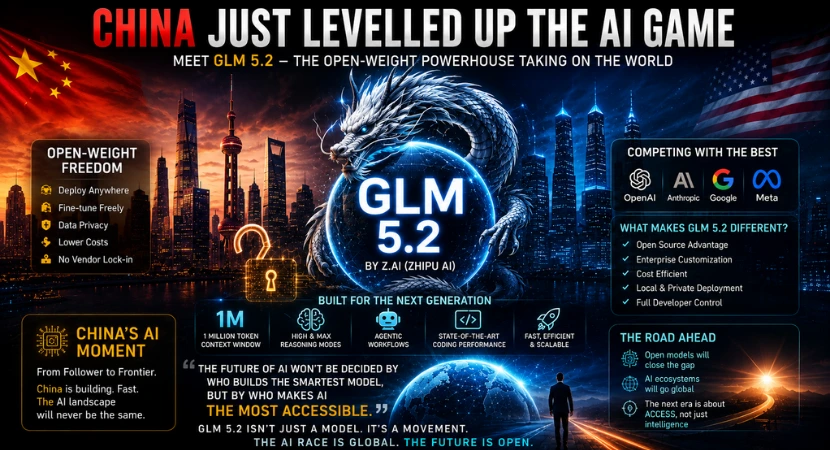
For the past few years, AI conversation has been dominated by OpenAI, Anthropic, Google, and Meta. Then China’s AI model GLM 5.2 launched.
And suddenly, the conversation changed.
Developed by Z.ai (formerly Zhipu AI), GLM 5.2 isn’t just another large language model. It’s a statement that China is rapidly closing the gap with leading USA AI models.
Recent industry evaluations place this China’s AI model among the strongest models for coding, long-context reasoning, and autonomous agent workflows.
What Makes GLM 5.2 Different?
Unlike most frontier AI models that operate behind paid subscriptions and proprietary APIs, GLM 5.2 embraces an open-weight approach.
That means developers and enterprises can:
✅ Deploy it on their own infrastructure
✅ Fine-tune it for domain-specific tasks
✅ Keep sensitive data private
✅ Reduce dependence on cloud-only AI providers
For many organizations, this level of flexibility is just as valuable as benchmark performance.
China’s AI model: What Are The Standout Key Features of GLM 5.2
China’s AI model GLM 5.2 introduces several capabilities aimed at enterprise AI infrastructure and software engineering:
- A 1 million-token context window for analyzing massive codebases, lengthy documents, and complex projects.
- High and Max reasoning modes, allowing users to balance speed with deeper multi-step reasoning.
- Native support for agentic workflows, enabling AI systems to plan, execute, and refine long-running tasks.
- Open deployment options that reduce vendor lock-in and support private, on-premises environments.
How This China’s AI Model is Different from Paid LLMs?
Models like GPT-5.5 and Claude typically provide a managed cloud experience with strong safety controls, integrated tooling, and subscription-based access.
GLM 5.2 takes a different path.
Instead of focusing primarily on closed commercial access, it prioritizes:
• Open deployment
• Enterprise customization
• Cost efficiency
• Local execution
• Greater developer control
The trade-off is that open models can also be modified in ways that bypass safeguards, which has raised cybersecurity concerns among researchers and policymakers.
China’s AI Progress Is Hard to Ignore
Just a few years ago, many viewed Chinese AI companies as followers.
Today, firms such as Z.ai, DeepSeek, Tencent, and Alibaba are releasing models that compete with global leaders while often emphasizing lower costs and more open distribution.
This isn’t simply competition between companies.
It’s becoming a competition between AI ecosystems.
Current Status of China’s AI Model
GLM 5.2 is available through Z.ai’s platform, with open-weight releases and broader developer access supporting adoption across research and enterprise use cases. It has quickly gained attention for coding, long-context reasoning, and autonomous software engineering tasks.
What Comes Next For China’s AI Model
Over the next few years, I expect three major shifts:
🔹 Open-source AI will continue to narrow the gap with proprietary models.
🔹 Enterprises will increasingly favor AI they can deploy and control themselves.
🔹 Competition will move beyond model intelligence toward infrastructure, governance, ecosystem, and developer experience.
The future AI leader may not simply build the smartest model. It may be the company that makes powerful AI model the most accessible.
Ending Note
One thing is becoming clear: The AI race is no longer just OpenAI vs. Anthropic vs. Gemini.
China’s AI model GLM 5.2 has firmly entered the conversation and it’s moving faster than many expected. It is hard to say that the future belongs to closed AI tools or open-weight models like GLM 5.2.
