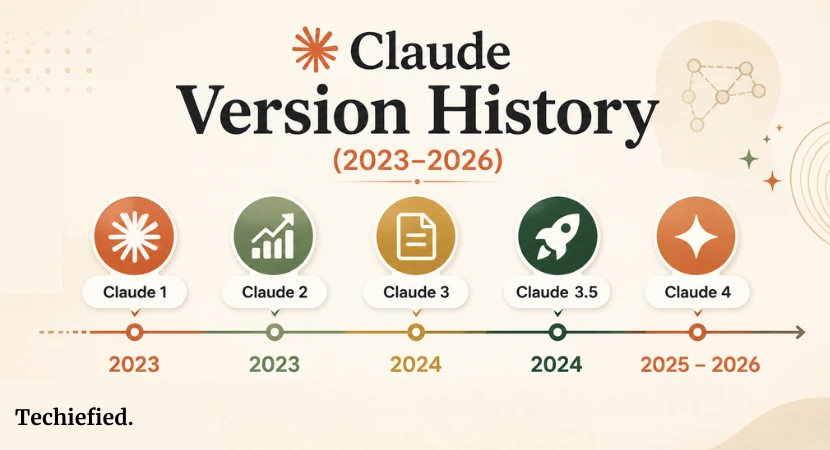
Claude has received 30+ major updates in just 6 months, from October 2025 to April 2026. That’s faster than any previous stretch in the model’s 3-year history.
If you’re choosing between Claude models right now, or trying to understand how Anthropic’s LLM has changed since its 2023 launch, the Claude version history matters. The wrong or deprecated model for your use case costs you money or performance.
This guide covers the complete Claude version history from March 2023 to June 2026. Every major release, with official release dates, key features, context window changes, and current status.
The Claude AI evolution from Claude 1.0 to Opus 4.8 covers 3 years of rapid development. Understanding that timeline tells you exactly where Anthropic is headed next.
What is the latest Claude version?
The latest Claude version is Claude 5.5 series, introduced in October 2026. The latest Claude model includes Claude Sonnet 5.5 and Claude Opus 5.5 as flagship models, along with Claude Haiku 5.5, a lighter option designed for faster, more efficient performance.
Quick Claude Version History at a Glance
If you want a fast answer on Claude version history comparison without reading the full timeline, this table has every active and retired model with release dates, context windows, and current status.
| Model | Release date | Context window | Key capability | Status |
|---|---|---|---|---|
| Claude 1 | March 2023 | ~9K (expanded to 100K mid-2023) | Constitutional AI training methodology | Retired |
| Claude 2 | July 2023 | 100K | Improved reasoning, coding | Retired |
| Claude 2.1 | Nov 2023 | 200K | Doubled context, reduced hallucinations | Retired |
| Claude 3 Haiku | March 2024 | 200K | Fastest, cheapest | Deprecated |
| Claude 3 Sonnet | March 2024 | 200K | Balanced performance | Deprecated |
| Claude 3 Opus | March 2024 | 200K | Top benchmarks, best reasoning | Deprecated |
| Claude 3.5 Sonnet | June 2024 | 200K | Outperformed Opus, best coding | Deprecated |
| Claude 3.5 Sonnet (Computer Use) | Oct 2024 | 200K | Mouse/keyboard interaction (public beta) | Beta |
| Claude Sonnet 4 | May 2025 | 200K | Enhanced reasoning, agentic skills | Active |
| Claude Haiku 4.5 | Oct 15, 2025 | 200K | Near-frontier performance, fastest | Active |
| Claude Opus 4.5 | Nov 24, 2025 | 200K | Maximum capability, step-change in vision/coding | Active |
| Claude Sonnet 4.6 | 2026 | 200K | Smart, efficient everyday model | Active |
| Claude Opus 4.6 | 2026 | 200K | Advanced capability model | Active |
| Claude Opus 4.8 | 2026 | 200K | Improved coding, agentic skills, reasoning | Active |
A few things worth noting. All models from Claude 2.1 onward have a 200K context window. Every Claude 1, 2, and 3 family model is now retired or deprecated. The latest Claude version as of June 2026 is Claude Opus 4.8 for maximum capability, with Sonnet 4.6 as the everyday workhorse.
Complete Timeline of Claude Version History (2023–2026)
Claude 1.0 (March 2023): the beginning
The first publicly available Claude model arrived on March 14, 2023, when Anthropic launched the Anthropic API with Claude and Claude Instant.
Claude 1.0 was built using Anthropic’s Constitutional AI training methodology, a framework where the model evaluates its own responses against a written set of principles rather than relying entirely on human feedback. The first version of that constitution, published in 2022, had 75 guidelines.
Claude 1 was invite-only and not publicly available. It competed with GPT-4 at launch and immediately attracted enterprise customers who cared about safety and brand risk.
Context window was initially ~9K tokens, expanded to 100K tokens in May 2023, making Claude the first foundation model from a frontier lab to reach that context window size.
Current status: Retired.
Claude 2.0 (July 11, 2023): major reasoning upgrade
Claude 2 was announced on July 11, 2023, accompanied by the public claude.ai chat interface. This was the first Claude model available to the general public.
Claude 2 scored 71.2% on the Codex HumanEval Python coding test, compared to Claude 1.3’s 56.0%. On the GSM8k math problem set, it scored 88.0% versus 85.2% for its predecessor. It also scored 76.5% on the multiple-choice section of the Bar exam, up from 73.0%.
The headline feature was a 100,000-token context window, roughly 75,000 words, at a time when GPT-4 was capped at 8,000 to 32,000 tokens. Businesses could now feed entire contracts, books, or codebases into a single request.
Current status: Retired.
Claude 2.1 (November 21, 2023): 200K context window
Tool use was first introduced as a beta on November 21, 2023 with Claude 2.1.
Claude 2.1 doubled the context window to 200,000 tokens, approximately 500 pages. It also dramatically reduced hallucination rates. It was far more likely to say “I am not sure” than to confidently produce a wrong answer, a quality that carried forward into every model that followed.
The 200K context window made Claude 2.1 viable for processing entire codebases, legal documents, and lengthy research papers in a single session.
Current status: Retired.
Claude 3 family (March 4, 2024): three-tier strategy
The Claude 3 family (Opus, Sonnet, Haiku) was announced together on March 4, 2024. Claude 3 Opus and Claude 3 Sonnet were generally available the same day, and Claude 3 Haiku became generally available on March 13, 2024.
Anthropic’s official announcement stated: “Today, we’re announcing the Claude 3 model family, which sets new industry benchmarks across a wide range of cognitive tasks.”
Claude 3 was an early adopter of vision input across all model tiers. All 3 models had a 200K context window.
| Model | Positioning | Best for |
|---|---|---|
| Haiku | Fastest, cheapest | Quick tasks, high-volume applications |
| Sonnet | Balanced | General-purpose use |
| Opus | Most intelligent | Complex reasoning, professional work |
Current status: All Claude 3 models deprecated.
Claude 3.5 Sonnet (June 20, 2024): the landmark release
Claude 3.5 Sonnet launched June 20, 2024 and outperformed the larger Claude 3 Opus on most benchmarks while costing 80% less. It was the moment developers stopped assuming the flagship model was the best choice.
Across GPQA, MMLU, and HumanEval, Claude 3.5 Sonnet matched or exceeded Claude 3 Opus, at $3 input and $15 output per million tokens, next to the $15/$75 tier the flagship was charging.
Current status: Deprecated (replaced by the October 2024 v2 and subsequently by Claude 4).
Claude 3.5 Sonnet with computer use (October 22, 2024): agentic capability
On October 22, 2024, Anthropic announced an upgraded Claude 3.5 Sonnet, a new model Claude 3.5 Haiku, and a new capability in public beta: computer use. Available on the API, developers could direct Claude to use computers the way people do, by looking at a screen, moving a cursor, clicking buttons, and typing text. Claude 3.5 Sonnet was the first frontier AI model to offer computer use in public beta.
Asana, Canva, Cognition, DoorDash, Replit, and The Browser Company began exploring these possibilities, carrying out tasks that required dozens and sometimes hundreds of steps. anthropic
Current status: Beta.
Claude 3.7 Sonnet (February 24, 2025): hybrid reasoning
Claude 3.7 Sonnet was announced on February 24, 2025, alongside the Claude Code research preview. It was Anthropic’s first hybrid-reasoning model with an extended-thinking mode.
Claude 3.7 Sonnet achieved over 70% on SWE-bench. Users could choose between a standard response mode and extended thinking for complex problems, with the thinking process visible rather than hidden.
Current status: Succeeded by the Claude 4 family.
Web search (March 2025) and research workflows (April 2025)
In 2025, Anthropic added a web search feature to Claude, giving it real-time access to current information beyond its training cutoff.
Anthropic then introduced Research and a Google Workspace integration for Claude, supporting multi-step, citation-backed investigations.
Claude 4 family (May 22, 2025): new generation
Claude Opus 4 and Claude Sonnet 4 launched on May 22, 2025, opening the Claude 4 generation. Claude Code also reached general availability that day.
Anthropic’s official announcement stated: “Today, we’re introducing the next generation of Claude models: Claude Opus 4 and Claude Sonnet 4, setting new standards for coding, advanced reasoning, and AI agents.”
Current status: Active.
Claude Haiku 4.5 (October 15, 2025): near-frontier speed
Claude Haiku 4.5 was released October 15, 2025.
Anthropic’s official description: “Our fastest and most intelligent Haiku model with near-frontier performance.” It was also the first Haiku-tier model to support computer use.
Current status: Active.
Claude Opus 4.5 (November 24, 2025): maximum capability
Released November 24, 2025. Anthropic described it as “our most intelligent model combining maximum capability with practical performance.” Key improvements included step-change gains in vision, enhanced coding, improved computer use, and a more accessible price point than previous Opus models.
Current status: Active.
Claude Sonnet 4.6 and Opus 4.6 (February 2026)
Claude Sonnet 4.6 was released February 17, 2026. Anthropic describes Sonnet 4.6 as a smart, efficient model for everyday use. Opus 4.6 is the advanced capability model in the same family. Both use 200K context windows.
Current status: Active.
Claude Opus 4.8 (May 28, 2026): current frontier
Claude Opus 4.8 was announced on May 28, 2026, and is the current Claude frontier model, released roughly 42 days after Opus 4.7.
Anthropic’s official release note states: “Claude Opus 4.8 shows improvements over Opus 4.7 in coding, agentic skills, reasoning.”
Opus 4.8 is roughly 4x less likely than 4.7 to let flaws in its own code pass unremarked, scores 84% on Online-Mind2Web (browser agent), and is the only model to complete every case end-to-end on Hebbia’s Super-Agent benchmark.
Current status: Active and current latest Claude version.
Which Claude Model Should You Use in 2026?
Three active Claude models cover nearly every use case. Here’s how to pick the right one.
Claude AI Pricing at a glance
As of May 2026, Claude Haiku 4.5 is priced at $1.00 input / $5.00 output per million tokens, Claude Sonnet 4.6 at $3.00 / $15.00, and Claude Opus at $5.00 / $25.00. Output tokens cost 5x input across all current models.
| Model | Input (per 1M tokens) | Output (per 1M tokens) | Best use case |
|---|---|---|---|
| Haiku 4.5 | $1.00 | $5.00 | Classification, extraction, routing, annotation at volume |
| Sonnet 4.6 | $3.00 | $15.00 | Production workloads, coding, content generation, RAG |
| Opus 4.8 | $5.00 | $25.00 | Complex reasoning, autonomous agents, high-stakes accuracy |
Claude Haiku 4.5: High-Volume, Low-Cost Tasks
Haiku 4.5 is the right choice when speed and cost matter more than reasoning depth. For extraction, routing, moderation, or annotation at volume, Haiku is often the right answer regardless of what Opus can do.
It’s also the only Haiku-tier model with computer use support, which matters for agentic pipelines that need to stay cost-efficient.
Pick Haiku 4.5 for: document triage, content moderation, chatbot first-response layers, summarization at scale.
Claude Sonnet 5: The Default For Most Teams (Updated)
Sonnet 5 replaced Sonnet 4.6 as the default for Free and Pro plans on June 30, 2026. It delivers near-Opus 4.8 coding performance at Sonnet cost, with a 1-million-token context window and adaptive thinking.
Launch pricing of $2/$10 per million tokens (through August 31, 2026) makes it the best value proposition Anthropic has shipped.
After the promo period, standard pricing returns to $3/$15.
Pick Sonnet 5 for: coding, long-context document work, content pipelines, most API production use cases, Claude Code workflows.
Claude Opus 5: Maximum Quality and Reasoning
Opus 5 delivers a step-change over Opus 4.8, with Anthropic describing it as coming close to Fable 5’s frontier intelligence at half the price. It runs with thinking on by default, supports the full effort ladder including xhigh and max, and offers a fast mode at ~2.5x speed.
It became the default model on the Claude Max plan and is the right choice when autonomous reasoning, code quality, or legal and financial accuracy is what you are paying for.
Pick Claude Opus 5 for: Complex agentic workflows, multi-step autonomous tasks, graduate-level reasoning, production code review, Fable-level tasks at Opus pricing.
When to Use Claude Fable 5.1
Claude Fable 5.1 is the current frontier model, announced September 1, 2026. It keeps the same $10/$50 pricing as Fable 5 but lowers cache reads to $0.25 per million tokens.
Pick Claude Fable 5.1 for: Maximum frontier research, complex scientific work, high-stakes autonomous tasks where cost is secondary to capability.
Claude Opus 4.7 (April 16, 2026)
Claude Opus 4.7 was announced on April 16, 2026, as a direct upgrade to Claude Opus 4.6.
Key improvements included:
- 3.75x vision resolution increase to 2,576 pixels, directly improving document and UI workflows
- New xhigh reasoning effort level enabling deeper inference at higher cost and latency
- Agentic self-checking — the model verifies its own mid-task outputs, reducing error propagation
- Task budgets for explicit resource limits on long-running agents
- Launched alongside Claude Design, a visual prototyping tool
Pricing remained unchanged at $5.00 input / $25.00 output per million tokens.
Current status: Active.
Claude Opus 4.8 (May 28, 2026): Reliability and Agentic Judgment
Claude Opus 4.8 was announced on May 28, 2026, roughly 42 days after Opus 4.7, the shortest gap so far between consecutive Claude Opus releases.
It focused on honesty and reliability: Anthropic reports it is about four times less likely than Opus 4.7 to let flaws in code it has written pass unremarked.
It also delivered more efficient tool calling, stronger agentic judgment, and improved computer-use performance (84% on the Online-Mind2Web benchmark).
It launched alongside the Dynamic Workflows research preview in Claude Code and user-facing effort control in claude.ai and Cowork.
Current status: Active. Retirement not sooner than May 28, 2027.
Claude Opus 5 (July 24, 2026): Opus-tier step-change
Claude Opus 5 was announced on July 24, 2026, as a step-change improvement over Claude Opus 4.8. Anthropic described it as coming close to Claude Fable 5’s frontier intelligence at half the price.
Key features: 1-million-token context window, 128K output tokens, thinking on by default, full effort ladder (low / medium / high / xhigh / max), and a fast mode at ~2.5x default speed.
It became the new default model on the Claude Max plan.
Current status: Active. Most capable Opus-tier model.
Claude Fable 5 (June 9, 2026): the Mythos-class frontier
Claude Fable 5 was announced on June 9, 2026, as Anthropic’s first Mythos-class model available to the general public. It introduced a fourth tier above Opus, with approximately 5 trillion parameters.
Key specs: 1-million-token context window, 128K output tokens, always-on adaptive thinking, and safety classifiers that automatically fall back to Claude Opus 4.8 for flagged requests.
Pricing: $10 input / $50 output per million tokens.
Note: Access was suspended June 12–30, 2026 due to a US export-control directive, then restored globally on July 1, 2026.
Current status: Active (superseded by Fable 5.1 for frontier use).
Claude Sonnet 5 (June 30, 2026): near-Opus at Sonnet cost
Claude Sonnet 5 launched on June 30, 2026, as Anthropic’s most capable Sonnet-tier model. It brings near-Opus intelligence to coding and agentic work at Sonnet pricing.
It became the default model for Free and Pro plans, offering:
- 1-million-token context window and 128K output tokens
- Adaptive thinking and the full effort range including xhigh
- Launch pricing of $2/$10 per million tokens through August 31, 2026; standard pricing $3/$15 thereafter
Current status: Active. Default for Free and Pro plans.
Deprecated And Retired Claude Models
Anthropic does not keep old models running indefinitely. Anthropic uses three lifecycle states: Active (fully supported and recommended), Legacy (no longer updated, may be deprecated), and Deprecated (still functional but not recommended, with a retirement date assigned).
One critical thing to understand: Anthropic won’t silently redirect your calls to a newer model. When a model is retired, your requests simply fail. No grace period. No fallback.
Claude Version History: Full retirement log
The Claude 3 generation has fully retired by April 2026.
Claude 3 Sonnet retired on July 21, 2025, Claude 3 Opus on January 5, 2026, and Claude 3 Haiku on April 20, 2026. The Claude 3.5 generation, including the original Sonnet, v2, and Haiku, is also fully retired as of February 19, 2026. Claude 3.7 Sonnet retired on the same date.
| Model | Retirement date | Replacement |
|---|---|---|
| Claude 2, Claude 2.1 | 2025 | Claude Sonnet 4.6 |
| Claude 3 Sonnet | July 21, 2025 | Claude Sonnet 4.6 |
| Claude 3 Opus | January 5, 2026 | Claude Opus 4.6 / 4.8 |
| Claude 3.5 Sonnet (v1 + v2) | February 19, 2026 | Claude Sonnet 4.6 |
| Claude 3.5 Haiku | February 19, 2026 | Claude Haiku 4.5 |
| Claude 3.7 Sonnet | February 19, 2026 (retired from API) | Claude Sonnet 4.6 |
| Claude 3 Haiku | April 19–20, 2026 | Claude Haiku 4.5 |
| Claude Sonnet 4 | June 15, 2026 | Claude Sonnet 4.6 |
| Claude Opus 4 | June 15, 2026 | Claude Opus 4.6 / 4.8 |
Last Word on Claude Version History
The Claude version history from 2023 to 2026 tells one story: Anthropic ships faster every year, and the gap between generations is shrinking. The latest Claude model, Opus 4.8, sits at the frontier today, but the 4.6 family handles 95% of real-world workloads at a fraction of the cost.
If you’re building on the Claude API in 2026, pick the right tier, watch the deprecation page, and you won’t need to scramble when the next wave lands.
